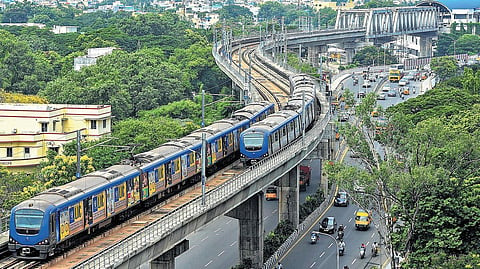

CHENNAI: The union housing ministry has rebuffed Tamil Nadu’s bid to revive stalled metro rail projects in Coimbatore and Madurai for the second time, rejecting the state government’s arguments on ridership, travel-time savings and population thresholds in a pointed rebuke that leaves both schemes in limbo.
In a letter dated July 22 to the state’s chief secretary, the Ministry of Housing and Urban Affairs (MoHUA) disputed nearly every technical justification put forth by Chennai Metro Rail Limited (CMRL) and the state government for the two projects, arguing that the detailed project reports overstate the case for elevated rail over cheaper bus-based alternatives.
The exchange, which began with an MoHUA note last year, discusses whether Coimbatore and Madurai – Tamil Nadu’s second- and third-largest urban centres – generate enough demand and time savings to justify metro systems, or whether upgraded bus rapid transit would serve just as well at a fraction of the cost.
The ministry rejected CMRL’s calculation that metro would cut a 7.5 km peak-hour trip by eight minutes over road transport. Factoring in walking and waiting time at stations, MoHUA said, “There will be hardly any savings in time by metro,” and noted that time and cost savings typically become decisive drivers of modal shift only for trips of 15 km or more, well above the average trip lengths CMRL cited for both cities.
A top government official, reacting to the rejection, told TNIE that the ministry’s position reflects lessons drawn from smaller cities that have already built metro systems. Journey times in such cities are inherently short regardless of network length, the official said, and once the time taken to reach a station from street level at the origin and back down to street level at the destination is added in, the net time saved by rail over road is negligible.
That dynamic, the official said, has depressed ridership in cities such as Indore, and is likely why the centre is now reluctant to sanction metro rail in any new city.
The ministry also said CMRL had tried to justify higher projected ridership for Coimbatore’s shorter corridor than for Chennai’s much larger metro network, while itself conceding that Coimbatore’s city bus system is underdeveloped. A metro without adequate feeder bus services and last-mile connectivity “cannot fetch ridership”, the letter said.
MoHUA repeatedly linked that weakness to Tamil Nadu’s non-participation in the centre’s PM e-Bus Sewa scheme, which it said could have strengthened city bus fleets in both Coimbatore and Madurai, and provided the last-mile links metro ridership depends on.
The ministry disputed the state’s use of 2022 planning-year estimates – 29.7 lakh for Coimbatore and 29.15 lakh for Madurai – to clear the 2 million mark (city population threshold) required under the Metro Rail Policy, 2017. Going by 2011 Census data, MoHUA said, Coimbatore’s core municipal corporation area houses only 15.84 lakh people, with much of the wider local planning area population unlikely to use a metro confined largely to the city corporation limits.
The population of the core Madurai Municipal Corporation area is about 10.18 lakh as per 2011 Census data.
The ministry noted that the state had acknowledged less than 20-metre right of way along stretches of the proposed Coimbatore corridors, implying likely demolition of structures during construction, and pointed to slow execution on existing projects as a cautionary benchmark.
The ministry clarified it had no objection in principle to either at-grade or elevated bus rapid transit systems, and reiterated that population size alone was not a prerequisite for metro approval, a caveat that appeared to aim at closing off further appeal on that ground. Earlier, the centre had rejected the TN proposal in November last year.
End of the line
MoHUA rejects CMRL’s calculation that metro would cut peak-hour trip by 8 mins
A minimum population of 20 lakh is required to implement a metro rail project
Centre flags TN’s decision not to participate in PM e-Bus Sewa scheme
Centre argues DPRs overstate elevated rail over cheaper bus-based alternatives
