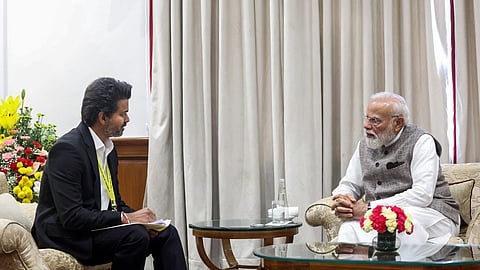

CHENNAI: Tamil Nadu Chief Minister C Joseph Vijay has written to Prime Minister Narendra Modi, describing the Centre's reply in the Rajya Sabha on the proposed Mekedatu dam project as "disappointing" and urging the government to withdraw it, saying it overlooks settled legal principles governing inter-state river disputes.
Vijay contended that the reply overlooked the final award of the Cauvery Water Disputes Tribunal (CWDT) and the settled legal principles governing inter-State river disputes.
"Protecting the integrity of the Tribunal Award and the judgment of the Supreme Court (SC) is essential for maintaining confidence in the constitutional mechanism governing inter-State rivers," Vijay said, seeking the Prime Minister's intervention "in the larger interest of justice, federal harmony and faithful implementation of judicial decisions."
The letter follows a written reply by the Union Minister of State for Jal Shakti to an unstarred question in the Rajya Sabha on July 27, raised by PMK president and MP Anbumani Ramadoss.
The Minister stated that the Supreme Court's February 16, 2018 judgment on the Cauvery water dispute did not expressly require Karnataka to obtain the consent of the lower riparian States before constructing a structure across the Cauvery River.
Vijay described the reply as "disappointing" and said it was inconsistent with the settled legal principles governing inter-State water disputes.
The development comes a week ahead of Vijay's proposed meeting with Karnataka Chief Minister DK Shivakumar on the release of Cauvery water.
In his letter, Vijay said the Union Minister's reply appeared to have been issued without taking into account the settled legal position requiring the consent of lower riparian States.
Referring to the Supreme Court's Constitution Bench judgment in the Karnataka-Andhra Pradesh Almatti case, he said the apex court had made it clear that an upper riparian State must obtain the consent of lower riparian States before raising the height of a dam and that such a project also requires the approval of the Union government.
"In the Karnataka-Andhra Pradesh Almatti case, the apex court has ruled that consent of lower riparian state is absolutely necessary," he said.
"Hence, that reply given by the Minister of State for Jal Shakti (Unstarred Question No 876 in Rajya Sabha) dated July 27, 2026 without referring to the settled law and legal principles in interstate water issues may be withdrawn," Vijay urged Modi in the letter.
Referring to the CWDT Award, Vijay said the Supreme Court had upheld Clause XVIII, which permits States to regulate water within their territories only in accordance with the Tribunal's directions.
He argued that any project capable of affecting the regulated flow of the Cauvery must therefore be examined for consistency with the Award.
The Chief Minister also cited the Tribunal's observations on Kerala's Pambar Hydroelectric Project, saying they demonstrated that the CWDT attached importance not only to the annual allocation of water but also to the coordinated regulation of releases to protect downstream interests.
He further referred to Clauses XI and XX of the Tribunal Award, which, he said, require consultation and mutual agreement before any upper riparian State takes action affecting scheduled deliveries to downstream States.
He added that any modification to the Award could only be made through agreement among the party States.
Asserting that the proposed Mekedatu project could not be treated merely as an engineering proposal, Vijay said its legal permissibility must first be examined in the light of the final CWDT Award, the Supreme Court's February 16, 2018 judgment and the rights of the lower riparian States.
The Chief Minister also pointed out that the Detailed Project Report submitted by Karnataka in 2019 had been returned by the Central Water Commission for revision to ensure compliance with the Tribunal Award and applicable guidelines. This, he said, demonstrated that compliance with the Award remained an indispensable precondition.
Vijay urged the Prime Minister to ensure that no statutory or administrative approval is granted to the Mekedatu project unless it is demonstrably consistent with the CWDT Award and the Supreme Court's judgment.
He also called on the Centre to safeguard the rights of the lower riparian States, both in terms of the quantity of water allocated and the regulated pattern of releases.
"Any future consideration of the project shall be undertaken only after a comprehensive technical and legal examination, taking into account the concerns of all lower riparian States," he said.
Describing the Cauvery as "the lifeline of millions of farmers and citizens across southern India", Vijay reiterated that protecting the integrity of the Tribunal Award and the Supreme Court judgment was essential to maintaining confidence in the constitutional framework governing inter-State rivers.
(With inputs from PTI and ANI)
