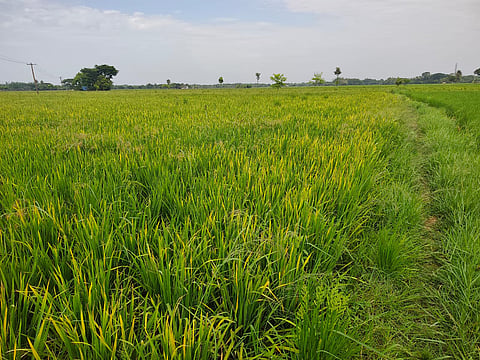

MAYILADUTHURAI : Standing Kuruvai paddy crops in Mayiladuthurai have lost their healthy green colour due to an intense heatwave and the spread of yellow disease, leaving farmers worried about heavy yield losses.
According to the Agriculture department, Kuruvai has been cultivated on about 39,400 hectares in the district this season. Farmers said that while those with borewell irrigation in Mayiladuthurai, Kuthalam, Tharangambadi and Sirkazhi blocks raised the crop using pump sets, many others were unable to take up cultivation after the Mettur dam was not opened on June 12 due to inadequate storage, leaving vast stretches of farmland fallow.
“The crops raised during April and May have now reached the heading stage. However, the failure of the expected summer rains, coupled with prolonged high temperatures and hot winds, has triggered widespread incidents of yellow disease and leaf blight in several villages,” said R Anbalagan of the Delta Irrigation Farmers Association.
He also added that the absence of irrigation water from the Mettur dam has added up to the dryness in the paddy fields. “Farmers borrowed money and relied on borewell irrigation to save the crop. But the severe heat and hot winds have caused yellow disease to spread rapidly. With the crop at the heading stage, we fear months of hardwork may go in vain,” said K Ashokan, another farmer.
Agriculture department officials said they had assessed the affected fields and issued advisories to farmers on measures to mitigate the impact of the disease. Officials also added that the affected crops were TPS 5 paddy varieties.
