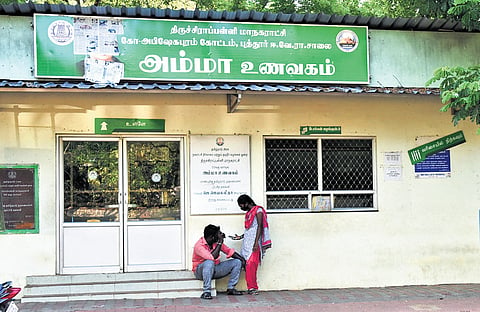

CHENNAI: To improve the services offered by Amma Unavagams and ease the burden on urban local bodies facing staff shortage, former government officials have suggested to bring all such canteens under a separate cooperative society managed by the cooperation department.
Such a move is expected to significantly enhance the management and functioning of the canteens, which provide food at heavily subsidised rates across Tamil Nadu. It could also improve the financial sustainability of Amma canteens while extending additional benefits to their employees.
Sources said the proposal would also relieve urban local bodies – including the Greater Chennai Corporation (GCC), municipal corporations and municipalities – of the responsibility of operating Amma canteens, a non-core activity.
Urban local bodies are primarily tasked with providing essential civic services such as solid waste management, drinking water supply, drainage maintenance, bus stand upkeep, and other public amenities. At present, 383 Amma canteens are managed by the GCC, while another 237 function under the supervision of other urban local bodies across the state. The average daily footfall of Amma canteens in Chennai is 1.03 lakh.
S R Venkatesan, former joint registrar in the cooperation department, recalled how communist leader A K Gopalan played a key role in converting the Indian Coffee House restaurant chain into a cooperative society in Thrissur, Kerala, in 1958. “Today, the cooperative runs around 500 outlets across India, including in Chennai and several other cities. Similarly, Amma canteens can also be brought under a cooperative model,” he said.
According to Venkatesan, bringing all the 600-odd Amma canteens under a dedicated cooperative society would strengthen management and improve service delivery to economically disadvantaged sections of society.
“Under this model, government officials or elected representatives could oversee the operations, while the government continues to provide subsidies to support the canteens. Employees would also be eligible for benefits such as provident fund, bonuses, and other welfare measures on a par with cooperative-sector employees,” he added.
A section of retired officials from the municipal administration department told TNIE that since the launch of Amma canteens in 2013 by the AIADMK government, it has remained unclear why urban local bodies are entrusted with a commercial activity such as running subsidised canteens for the economically weaker sections.
“Such responsibilities inevitably divert officials of the GCC and other urban local bodies from their core functions. The operation of the canteens could instead have been entrusted to a cooperative society or another specialised agency,” said a retired official.
An official from the cooperation department said the matter ultimately rests with the state government.
