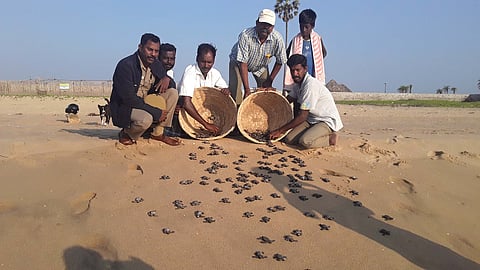

CHENNAI: After witnessing an alarming spike in Olive Ridley turtle deaths last year, Tamil Nadu has managed to nearly halve the mortality rate during the 2025-26 nesting season.
According to the official statistics, accessed by TNIE, Olive Ridley mortality dropped from 1,575 turtles last season to 786 this year – a 50% decline. Officials attributed this to stricter enforcement of fishing regulations, increased use of Turtle Excluder Devices (TEDs), extensive patrolling and awareness campaigns among fishing communities.
During the current season, 1,986 nests were protected, 2,29,668 eggs collected, and 1,91,560 hatchlings released into the sea through a network of 52 hatcheries spread across coastal districts in Tamil Nadu.
The achievement reflected the coordinated action across multiple agencies said Supriya Sahu, additional chief secretary, Environment, Climate Change and Forests Department. “This was made possible through the collective efforts of the forest department, fisheries department, Indian Coast Guard, marine police, local bodies, conservation organisations, and most importantly, the fishing community. Tamil Nadu remains committed to strengthening science-based conservation and community participation to ensure the long-term survival of this iconic marine species,” she said.

Also, this season, Chennai emerged as the top nesting hub. The Chennai Wildlife Division recorded 656 nests, 74,143 eggs and 51,569 hatchlings released. Cuddalore followed with 458 nests, 55,348 eggs and 50,019 hatchlings released. Meanwhile, Nagapattinam recorded 267 nests, 30,499 eggs and 25,762 hatchlings released.
Forest officials said another notable development was the increased nesting activity observed north of Chennai towards Pulicat. “Traditionally, Nagapattinam/Cuddalore has been our biggest nesting hotspot. This year, Chennai topped the list; we also noticed brisk nesting activity towards Pulicat.
These shifts make it important for us to better understand turtle migration routes, habitat use and nesting behaviour. We plan to continue and expand our satellite tagging programme so that we can generate more scientific data on turtle movements along the Tamil Nadu coast,” Rakesh Kumar Dogra, Principal Chief Conservator of Forests and Chief Wildlife Warden, said.
A seasonal ban was enforced on mechanised fishing within five nautical miles of nesting and breeding areas from January to April and a total of 2,663 TEDs were distributed to fishermen for installation in trawl nets. Joint enforcement teams conducted 172 patrols during the season. Authorities filed 172 chargesheets, imposed fines totalling Rs 4.05 lakh on 60 boats, and impounded five vessels for violations.
“The use of TEDs has improved considerably among fishermen, but we have not yet achieved 100% compliance. Another challenge is the large number of non-functional transponders on fishing vessels. We have already taken up the matter with the union government because vessel tracking is critical for effective enforcement and conservation,” Dogra said.
Ten nesting Olive Ridley turtles were fitted with satellite transmitters by researchers from the Wildlife Institute of India and the Advanced Institute for Wildlife Conservation to study offshore movement patterns. Another 89 turtles were fitted with flipper tags for long-term identification and monitoring. Researchers documented re-nesting behaviour in eight tagged turtles, including one Kayal, which nested three times during the season, and one Megalai, which nested twice.
Officials said the state will now focus on improving TED compliance, repairing more than 1,200 non-functional vessel transponders, strengthening enforcement and expanding scientific studies to better understand turtle populations and migration patterns along the Tamil Nadu coast.