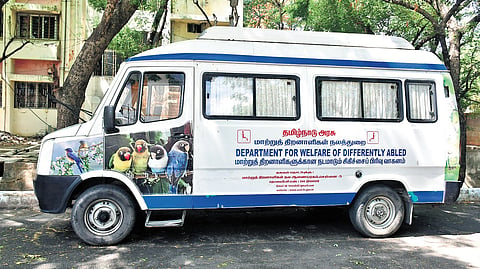

VELLORE: From 10.30 pm every night, Ashok Kumar* hears his daughter, Archita* (13), cry in pain and writhe in discomfort due to a locomotor disability. Kumar and his wife, Sheela*, spend the night helplessly trying to ease her suffering, but her struggle often continues until 3-4 am, when she sleeps from exhaustion.
More often than not, however, they can do little but listen to their daughter’s cries echo through the house. “Either my wife or I fold her legs, give a few massages. But, on some nights, nothing works,” said Ashok.
This was not so difficult for the family three years ago, when a mobile therapy unit (MTU) vehicle would bring to their home a physiotherapist who would treat Archita, said Kumar. For over five years, she underwent this home-based physiotherapy before the programme was stopped three years ago, reportedly due to a lack of funds.
Officials attributed several administrative issues — including reduced allocation of funds, irregular salary payments, and lack of trained staff — to the non-operation of MTU vehicles. “Hardly around `1 lakh is annually allocated for the programme. It is difficult to manage with that considering the rising fuel charges,” said an official.
An MTU vehicle has three staff members – a driver, an attender, and a physiotherapist. Some of them, who are contract staff, said they have not received salaries for the last three to four months. Moreover, the salaries have not been revised for the last 10 years, and the vehicle has not been upgraded since it was provided over a decade ago.
In July 2013, the then CM J Jayalalithaa issued a government order (G.O. 70) that allotted a vehicle in each district to visit disabled children up to six years of age in their homes to provide physiotherapy.
In June 2015, the programme was formally launched in the state’s then 32 districts. The sudden withdrawal of this crucial facility has negatively affected beneficiaries like Archita and their families, who are unsure how to proceed.
Mildly affected children can receive physiotherapy at their special schools. However, those who cannot move out of their homes have been hit the most after the service was halted. “The MTU vehicle, besides providing physiotherapy, used to distribute other aid equipment, like hearing aids and welfare schemes to differently-abled children at their homes,” said Gopal Rajendran, an activist with The Tamil Nadu Association for the Rights of All Types of Differently-abled and Caregivers.
While physiotherapy is not available at the doorstep, it is still offered during weekly camps held for the disabled persons at government hospitals in Adukkamparai and Gudiyatham, according to officials in the differently-abled department in Vellore.
This offers little relief as Archita has grown older and her parents find it difficult to lift her and carry her to the hospital for treatment. “Whatever little physiotherapy I know, I am doing it. However, it won’t be like a professional doing it, right?” he asked.
Speaking to TNIE, S Babu, District Differently-abled Welfare Officer, said the gaps would be fixed once the Vizhuthugal, a one-stop centre providing services to disabled persons, opens in Vellore and added that all these centres would be functional within a month.
*Names changed on request.
