
CHENNAI: The high-level committee constituted by the state government to probe into the deadly ammonia gas leak at M/s St. Peter & Paul Seafoods Exports Private Limited in Tiruvallur has submitted its report to the chief secretary. The report has flagged several safety lapses that were highlighted by TNIE, including the emergency alarm system failure during the leakage.
The committee, comprising the director of industrial safety and health, the member-secretary of the TNPCB, and the additional director of public health, was tasked with submitting an interim report within 24 hours and the final one within three days. According to sources, the report has also raised serious concerns over the living conditions of migrant workers, particularly young women housed inside the factory premises.
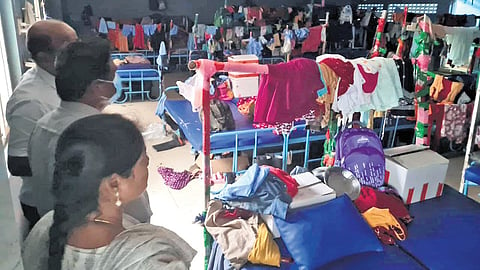
Visuals from the workers’ hostel reveal cramped and unhygienic conditions, with dozens of beds packed into a poorly ventilated hall. Clothes hung from makeshift lines between cots, personal belongings were piled around sleeping spaces, and there appeared to be little room for safe movement in the event of an emergency.
These have prompted the Tamil Nadu Pollution Control Board (TNPCB) to reconsider conditions attached to industrial approvals. Sources said the board is contemplating new conditions in future Consent to Establish and Consent to Operate approvals, including mandatory worker accommodation outside factory premises and the creation of adequate sterile buffer zones around hazardous installations to minimise the impact of industrial accidents on workers and nearby communities. It, however, is the Directorate of Industrial Safety and Health, which needs to be completely overhauled.
Notably, the TNPCB’s Consent to Operate issued to M/s St. Peter & Paul Seafoods Exports Private Limited in April 2026 required the unit to ensure compliance with ambient ammonia standards, maintain pollution control systems, and immediately report any upset condition likely to result in increased emissions. The consent also required adherence to provisions pertaining to public safety in the event of hazards.
Former local councillor D Kumar alleged that the factory initially operated on about 1.5 acres before expanding significantly over the years. “Despite repeated objections from nearby villages, permissions were granted for expansion,” he said.
Sources said the report noted that many workers were not trained on basic emergency response during a chemical leak. Workers had earlier alleged that no alarm sounded when ammonia leaked, resulting in delayed evacuation.
