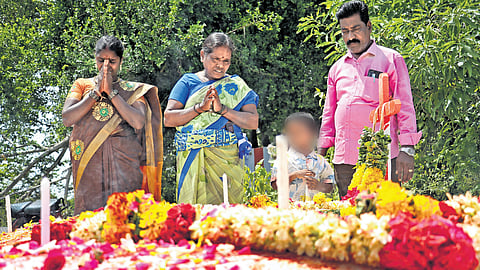

KALLAKURICHI: Two years after the hooch tragedy in which 69 lives were lost to methanol-laced illicit liquor in Kallakurichi, the communities of Karunapuram and Kottaimedu villages, located on the foothills of the Kalvarayan Hills, are slowly picking up the pieces.
But the struggle to move forward extends beyond the victims’ families. As widows who lost their husbands in the tragedy wait for stable jobs, grandparents struggle to raise orphaned children, and broken families toil to rebuild future, a parallel fight is on to end the arrack menace in the rugged terrain.
The number of arrack black spots has come down to seven from 22 over the last two years, says a prohibition enforcement wing (PEW) official, acknowledging the existence of traces of the trouble.
After the tragedy in June 2024, the government transferred the entire PEW police personnel of the district for negligence. Patrolling and monitoring were also strengthened to curb the sale of hooch and other drugs. Arrack and hooch-related prohibition cases declined from 2,472 in 2024 to 742 in next 13 months till January 2026, but ganja is now slowly gaining ground.
People of Karunapuram and Kottaimedu are pinning their hopes on the new government, headed by C Joseph Vijay, and Kallakurichi MLA C Arul Vignesh to offer them deliverance from the scourge of drug and arrack even as the victims’ struggle to rebuild their lives continues.
Last Friday, the second anniversary of the hooch tragedy passed off quietly. The streets in the two villages were bereft of posters, memorial meetings, and candles that were seen last year. Survivors say life forces them to move on, but deep scars remain.

The government compensation of Rs 10 lakh to the families of each deceased person and Rs 5,000 a month towards education to each of the 34 children who lost either or both parents provided some immediate relief, but for many survivors, long-term rehabilitation still hinges on stable employment.
A Latha (46), wife of 53-year-old L Anil, who hails from Rajasthan, is struggling to put food on the table after her husband lost his sight. The government provided a one-time compensation of Rs 50,000, which Latha said was not enough even for medical bills. Anil used to earn nearly Rs 30,000 per month as a painter.
Now, Latha earns just Rs 80 to Rs 100 per blouse by tailoring. Over the past two years, Latha has accumulated unmanageable debt from local moneylenders just to survive. “I am struggling for steady income and need employment more than anything else.
Rehabilitation efforts must move beyond compensation,” she says. The wives of K Balu (31) and S Mayakannan (53), who were pushed to become breadwinners of their families after their husbands lost their eyesight in the 2024 tragedy, are also awaiting alternative employment opportunities.
The affected children too are just starting to rebuild their lives.
S Harish (17), a Class 11 student and ‘kho kho’ player, and his two siblings had lost both their parents to the tragedy. He aspires to become a footballer.
“My sister is in college. She lives with my other grandmother. My brother is studying in Class 10 and we both live together with our aaya (Muniyamma). I understand that I have to work very hard to build a good life as amma and appa are gone,” says Harish. A Muniyamma (61) is fighting to raise Harish, his sister S Kokila (19) and brother S Ragavan (15).
Working as a cleaner at a private school about 30 km away from home, Muniyamma struggled to make ends meet without a ration card and a proper job soon after her only daughter and son-in-law died. She received a ration card a few months back. The 61-year-old still continues to work far from her home because it pays her enough to manage the family.
G Regina (48) lost her son Praveen (28) to hooch. She is now raising his two grandsons with the government’s monthly aid. “My grandchildren receive a better education because of the fund. I want to live well until the kids grow up,” Regina says, capturing sentiments echoed across several affected families.
The rising drug menace, however, has turned into a challenge for the community trying to turn over a new leaf. M Swetha (29), of Karunapuram, says, “We want to move on with our lives — focus on career, children’s education and family.” The police, however, will always have no mercy in protecting the lives of the marginalised and will let any illegal activity thrive by taking bribes, she says, spotlighting the challenge they face in shrugging off the menace of substance abuse.
Kallakurichi superintendent of police I Shahnaz told TNIE that patrolling has been increased. “We have several Anti-Narcotics Task Force teams conducting regular raids and patrols across the district, especially in town areas. We are also steadfast in filing cases against culprits as part of the effort to control drug abuse,” the SP added.
Minister for Social Justice Vanni Arasu, the minister in-charge of Kallakurichi, told TNIE, “We will focus on the most vulnerable areas in the district to set up rehabilitation centres and alternative recreation hubs to promote healthy hobbies among adults and youngsters.”
The minister added that special camps would identify livelihood needs, and children of migrant and quarry workers, pregnant and destitute women would receive focused welfare interventions.
For families in Karunapuram and Kottaimedu, two years after the tragedy, remembrance has quietly given way to survival. Their hope now rests on whether rehabilitation, employment, and a drug-free future become realities rather than promises.
What they want is stable employment
The government compensation of Rs 10 lakh each to the families of deceased and Rs 5,000 a month for education to each of the 34 kids who lost their parents provided relief, but for many of them, long-term rehabilitation still hinges on stable employment