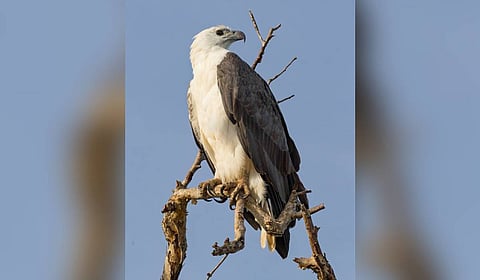

RAMANATHAPURAM: The White-bellied Sea Eagle, a majestic coastal raptor species, is facing increasing threats in Tamil Nadu due to habitat loss and human disturbances, according to a five-year study conducted in the Gulf of Mannar region. The findings of the study were published on June 26 in the international scientific journal -- Journal of Threatened Taxa.
Though the species has a strong presence in Australia and parts of Southeast Asia, its population in India, particularly along the Tamil Nadu coastline, remains a matter of concern, bird researchers said. The White-bellied Sea Eagle is among the largest coastal birds of prey, with a wingspan stretching between five and seven feet.
Equipped with powerful talons and a sharp beak, the eagle hunts fish and sea snakes along coastal waters. Researchers pointed out that the bird, and not the smaller Brahminy Kite, is the actual Garuda depicted in ancient mythology.
A continuous study on the species in the Gulf of Mannar region has been carried out for the past five years by environmentalist and bird researcher N Raveendran of Amrita Nature Foundation, along with Dr Baiju and research scholar Maithri.
The study found that the eagles, which traditionally depended on tall trees for nesting, are increasingly shifting to artificial structures such as electricity transmission towers, telecommunication towers and other man-made installations.
”The loss of large nesting trees due to cutting and increasing human interference in natural habitats are forcing these birds to choose unsafe alternatives like high-tension electricity towers for nesting,” said N Raveendran.
“Though these structures offer some protection from human disturbance, they pose a serious threat when young birds begin to fly, as they can collide with high-voltage power lines. Such risks can be avoided if their natural nesting habitats are protected,” he added.
The researchers noted that White-bellied Sea Eagles breed only once a year and lay one or two eggs. In most cases, only one chick survives after hatching.
During the previous breeding season, nesting activity was recorded in areas including Pudhumadam, Mandapam, Pamban, Vedalai and Dhanushkodi in Ramanathapuram district. While some nests were abandoned during the initial stages and others were deserted before completion, three nests located within a distance of three to four kilometres successfully supported breeding.
Initially, six chicks were recorded across the three nests. After one chick died, five juvenile White-bellied Sea Eagles survived and later began soaring over the coastal skies after attaining full growth. Researchers described the successful breeding of five young eagles as a positive sign compared to previous years.
“The increase in successful breeding indicates that suitable conservation measures can help revive the population of this important coastal predator. Protecting nesting trees and reducing disturbances around breeding areas are crucial,” Raveendran said.
The government has initiated programmes for the conservation of birds of prey. Researchers urged the government to strengthen awareness campaigns among coastal communities and protect critical habitats of rare raptor species such as the White-bellied Sea Eagle.
