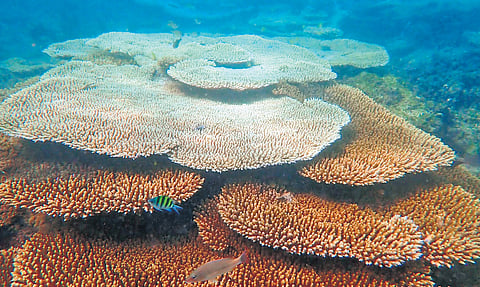

CHENNAI: Amid concerns over the impact of a developing El Nino on the coral reefs in the Gulf of Mannar and Palk Bay, a rapid underwater assessment has found that this summer’s coral bleaching remains limited, with no coral mortality recorded so far and early signs of recovery already visible.
The Indian National Centre for Ocean Information Services (INCOIS), in its first specialised El Nino bulletin released recently, warned that the climate phenomenon is expected to peak between November 2026 and January 2027.
The agency said the resultant above-normal sea surface temperatures could trigger more marine heatwaves, intensify coral bleaching, and affect marine biodiversity and fish stocks in the coming months, particularly during March-May 2027.
Against this backdrop, the forest department tasked scientists from the Thoothukudi-based Suganthi Devadason Marine Research Institute (SDMRI) with carrying out underwater monitoring.
The team conducted a rapid assessment between May 7 and 12 across reef sites in the Gulf of Mannar and Palk Bay. The survey covered reefs around 12 islands in the Gulf of Mannar across the Thoothukudi, Keelakarai and Mandapam regions, besides reef areas in Mandapam North in Palk Bay.
Coral restoration sites at Shingle, Valai, Thalaiyari, Kariyachalli and Koswari islands were also assessed. It found that sea surface temperatures had exceeded the coral bleaching threshold of 30°C, reaching up to 31.2 °C in parts of the Gulf of Mannar, resulting in bleaching in both natural reefs and coral restoration sites.
However, unlike the severe global bleaching events of 2010, 2016 and 2024, scientists found no evidence of coral mortality. “The rapid assessment indicates that there was some degree of coral bleaching but no mortality has been observed.
The corals are already showing signs of recovery as sea temperatures have started declining,” Akhil Tambi, Wildlife Warden, Gulf of Mannar Biosphere Reserve, told the TNIE.
Kariyachalli Island recorded the highest bleaching, followed by Vaan Island in the Gulf of Mannar. In Palk Bay, bleaching was higher at 13.9%, with more than three-fourths of the affected corals fully bleached. “We are aware of the developing El Nino and the risks associated with prolonged warming of sea surface temperatures.
Monitoring will continue in the coming months so that any changes in reef health can be documented and appropriate conservation measures taken,” Tambi added.
A comprehensive survey covering all 21 islands in the Gulf of Mannar and permanent monitoring sites in Palk Bay is scheduled to assess the reefs in greater detail.
