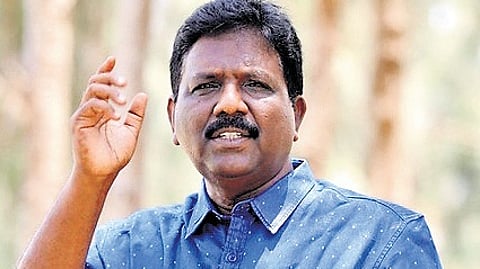

Amid criticisms from a section of activists and civil society that the ruling DMK has prioritised its new ally DMDK by allotting it 10 seats while failing to meet the expectations of its long-term and ideologically committed allies like the VCK and Left parties, writer, MP and VCK general secretary Dr D Ravikumar responds to such critique in an interview with TNIE’s Krithika Srinivasan.
Excerpts:
There is a growing perception that parties like VCK have become muted in recent years, by failing to strongly question the DMK government on issues of atrocities against Dalits or alleged lapses in taking necessary action.
That is not true. VCK has organised more anti-government struggles than the principal opposition party, the AIADMK. We were the first to organise a massive demonstration in Pudukkottai after the Vengaivayal incident. We also conducted statewide demonstrations during other incidents of atrocities. However, it is a fact that atrocities against Dalits have increased during the present DMK rule, as confirmed by NCRB data. The rise of right-wing ideology and police apathy are the key reasons. During Edappadi Palaniswami’s regime, police and bureaucracy were influenced by the RSS and BJP. The trend continued to some extent during the DMK rule as well.
Even BJP, which is criticised for communally divisive politics, gave representation for Dalit-Bahujan parties in Bihar and UP polls, but DMK, despite its progressive credentials, seems to be lagging behind while also failing to give enough representation for Left parties. Your view?
We are deeply concerned about the shrinking space for Left parties. Though we consider the VCK itself as a Left-oriented party, the reduction in their seats is painful. We will work hard to ensure victory in the seats allotted to the Left front. However, we cannot compare BJP’s divisive political approach with the situation in TN. Except for VCK, most Dalit parties in India have been co-opted by the BJP, which uses them to divide votes. In TN too, some fringe parties that invoke Ambedkar’s image have been co-opted by the Sangh Parivar.
Though TN has made major strides in terms of its economy, adoption of latest technology etc., caste differences still remain. Recent murders and violence in southern districts are a stark reminder. Can we attribute this to the lack of work at the grassroots level by parties like the Left and VCK?
Fundamentalism, whether religious or caste-based, exploits technology to its advantage. The spread of right-wing ideas through social media is a clear example. In TN too, social media platforms are increasingly used by hate-mongers, making it a key reason for fuelling casteism. In TN, we must distinguish between the non-Brahmin politics of the Justice Party and the anti-Brahmin politics of the Self-Respect Movement. The latter was Periyar’s idea of anti-Brahminism and had annihilation of caste at its core, which was not the case with the Justice Party. DMK followed Periyar’s legacy, and later Kalaignar continued on that path. However, the pressures of electoral politics have transformed their agenda of annihilation of caste into the idea of ensuring a “fair share” for all castes, now termed as social justice. VCK has consistently called upon Left parties for greater coordination, though they have been somewhat reluctant.
Is the VCK taking cognisance of the dangerous escalation in targeted social media abuse against women who voice out their opinion, regardless of party affiliation, by IT wings of all parties?
The growing influence of Sangh parivar is reflected not only in politics, but also in society. It reinforces patriarchy and threatens the space, autonomy of women. The danger of this regressive ideology lies in its ability to transcend the limits of the Sangh Parivar and influence other parties as well. The anonymity and lack of accountability on social media encourage abusive behaviour. We are addressing these within our party via ideological interventions and structural measures.
What lies ahead for Dalit or more broadly, anti-caste politics in TN?
Dalit politics has a bright future. We must work strategically during the census and delimitation exercises, as they present a significant opportunity to consolidate Dalit political power.
