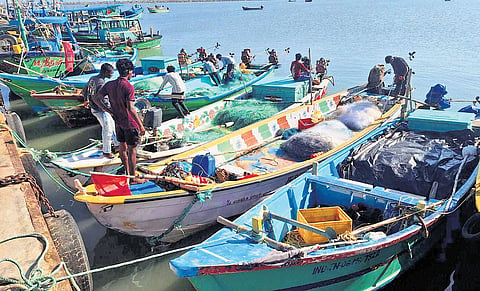

NAGAPATTINAM: An aggressive manifesto with major guarantees for fishermen could not translate into sweeping electoral gains for TVK, which managed to secure only 15 of the 40 coastal constituencies in the state. The party’s promises including `27,000 lean-season relief, subsidised diesel, `25 lakh accident insurance, permanent housing and a minimum support price (MSP) for fish were widely seen as targeted interventions for coastal livelihoods. However, observers said structural constraints, the limited electoral weight of fisher populations, the rural-urban divide, and the entrenched influence of Dravidian parties diluted their impact.
Tamil Nadu’s fishing community of around 12 lakh is spread across 608 villages along a 1,076-km coastline covering 40 Assembly seats. While TVK made inroads, its gains were largely concentrated in urban and peri-urban segments rather than traditional fishing hamlets. The most decisive win came in Sholinganallur, where ECR P Saravanan won by a margin of 96,780 votes.
This was followed by Ponneri (55,768) and Tiruvottiyur (53,564). In Chennai, constituencies such as Dr Radhakrishnan Nagar, Mylapore, Royapuram and Velachery delivered comfortable margins ranging between 14,000 and 50,000 votes. In Thiruporur, the margin was 39,351. In the southern belt, TVK registered strong wins in Thoothukudi (37,731) and Ottapidaram (29,083), while posting moderate margins in Cuddalore (15,519) and Radhapuram (12,313). The closest contests were seen in Srivaikuntam (1,186), Tiruvadanai (2,513) and Aranthangi (10,062), indicating a fragmented voter base.
Observers noted that although there was a perceptible shift among fishers towards TVK, driven by fatigue over long-pending issues and a search for alternatives, their numbers alone were insufficient to swing outcomes. “A significant share of coastal votes went to TVK, but the fisher population by itself could not determine results in these constituencies,” said S Velvizhi of the MS Swaminathan Research Foundation. Despite the inclusion of fisher-related issues, Velvizhi said the concerns of fisherwomen, who contribute equally to the fishing sector, remain largely unaddressed in the manifestos of all parties.
RMP Rajendra Nattar of the Indian National Fishermen Union pointed out that concerns such as environmental degradation and cross-border tensions continue to dominate. “Manifesto promises appear inclusive, but the core issue is the recurring detention of Indian fishers and seizure of boats by the Sri Lankan Navy. Earlier, CM MK Stalin would write to the centre after such incidents, but what is the long-term solution? Vijay has spoken about this during his campaign. We will have to see what impact he makes,” he said. On the proposed MSP for fish, Velvizhi cautioned that implementation would require significant groundwork. “Fishing practices, vessel types and storage capacities vary widely. MSP must be linked to quality, and without addressing these disparities, small-scale fishers risk losses due to spoilage,” she said.
Reflecting on the party’s performance, TVK’s Kilvelur candidate P Senthil Pandiyan, who lost by 2,278 votes to CPI(M)’s T Latha, attributed the outcome to a clear rural-urban divide. “If thalapathy (Vijay) had campaigned more extensively in coastal constituencies while introducing the candidates, the number of seats won could have been higher,” he said.
