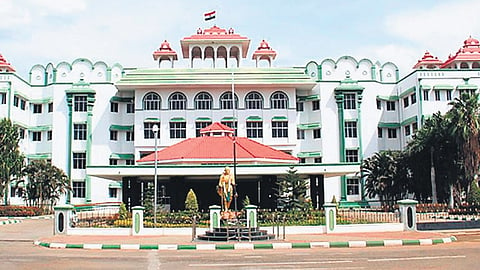

MADURAI: Observing that a child born to a convict, who is serving sentence for committing triple murder, would face stigma throughout its life, the Madurai Bench of Madras High Court refused to grant 21 days ordinary leave to a man convicted in Kachanatham triple murder case, to undergo fertility treatment.
Further, the court agreed with the contention of additional public prosecutor that leave under the Tamil Nadu Suspension of Sentence Rules, 1982, cannot be claimed as a matter of right and it is only a privilege given to the convict.
A bench of justices N Anand Venkatesh and KK Ramakrishnan made this observation while dismissing a petition filed by the convict's wife challenging the rejection order passed by the Superintendent of Madurai Central Prison denying leave to her husband. The judges said the couple, while planning to have a child, has ignored the right of the child, to be born.
"The child, when it enters this world, will grow up with a stigma that it is the child of a life convict, who is serving sentence for having committed a heinous crime involving triple murder. In such a scenario, this court cannot merely act upon the right that is claimed by the petitioner and ignore the interest of the child, which will carry such a stigma throughout its life," the judges said. Neither the petitioner nor the convict has the right to place the child in such an unfortunate position, they added.
Moreover, the theory of reformation is focused only on the convict and has nothing to do with the desire of a convict to have a child, they pointed out.
Since Rule 20 of the Tamil Nadu Suspension of Sentence Rules, which deals with the grounds for grant of ordinary leave, does not provide for granting ordinary leave to enable the petitioner and/or the convict to undergo fertility treatment, the judges held that they do not find any illegality in the rejection order.
I Muthumani (29) was one of the 27 persons who were sentenced to life imprisonment (three counts) on August 5, 2022, for murdering three Scheduled Caste men at Kachanatham village in Sivaganga on May 28, 2018. His conviction, along with 25 others (one person acquitted), was confirmed by the high court on February 26, this year. He is presently lodged in Madurai Central Prison.
Apprehending that granting him leave might endanger his life or cause law and order problem, the prison superintendent rejected his leave application on September 11, 2025.
Reacting to the observations, Retired HC judge, Justice D Hariparanthaman told TNIE that while the court’s decision may be correct as per the relevant rules, the observations are violative of Article 21 of the Constitution, which says no person should be deprived of his life or personal liberty except according to procedure established by law. "If the law permits the convict to come out on parole in future and the couple conceive a child during that period, can the court say they should not have a child because he is a convict?," he questioned.
KR Raja, an advocate and executive director of Global Network for Equality -India, which works to safeguard prisoners' rights and rehabilitation of children of prisoners, told TNIE that the decision to have a child is a personal choice of a married couple and neither the court nor any third party should decide their suitability for parenthood. "Modern prison jurisprudence in India recognises that imprisonment does not completely extinguish marital, reproductive, and emotional rights of prisoners, and conjugal association has often been viewed as part of reformation and rehabilitation. The Court could have confined its consideration to prison rules, security concerns, and statutory grounds for leave rather than making assumptions about the future social condition of the child. Stigmatizing an unborn child on the ground that one parent is a convict may also indirectly stigmatize thousands of children living outside prisons who are born to convicted persons. Such reasoning risks undermining rehabilitation, family bonds, and the human dignity of prisoners," he opined.
