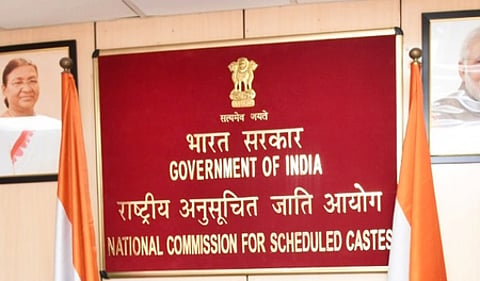

In India, the National Commission for Scheduled Castes (NCSC) and its state-level counterparts have been functioning very poorly. As of mid-2026, these bodies face significant administrative challenges amid a broader national crisis of judicial and quasi-judicial pendency.
While exact daily “live” counters for every state are not always aggregated in real-time, current data from the National Judicial Data Grid (NJDG) and NCSC annual reports indicate pendency as of May 2026. There is a significant backlog of over 20,000–25,000 complaints pending at the national level.
At the state level, pendency varies with population and other cultural factors. High-population states and the so-called economically backward states like Uttar Pradesh, Bihar, and Rajasthan account for the largest share of pending cases, primarily involving land disputes, service matters, namely reservations in promotions, and atrocities.
The majority of pending cases fall under service matters, such as delays in implementing roster systems and reservation policies in government jobs. As far as atrocities are concerned, complaints filed under the SC/ST (Prevention of Atrocities) Act that are awaiting commission inquiry before or alongside police action for years together. Cases related to the “creamy layer” debates and sub-categorisation within Scheduled Castes, which have gained momentum following recent Supreme Court rulings, are also pending.
The commissions currently operate under several systemic handicaps. Firstly, the commission operates in an advisory capacity. Under Article 338, the commission has the powers of a civil court to investigate, but its final recommendations are not legally binding on the government. They are often treated as mere “suggestions”.
Also, appointments to the commission are often based on political patronage. There is no independent, multi-stakeholder selection committee, which can lead to perceptions of partisanship. Many state commissions are understaffed, with several posts for members and investigators remaining vacant for years.
The NCSC is required to present annual reports to the President. However, these reports are frequently tabled in Parliament with a delay of 2–3 years, making the data and recommendations outdated by the time they are debated.
Despite moving toward online filing, rural victims often lack the digital literacy or access to track their cases, leading to a “ghost backlog” of abandoned complaints.
To transition from a “paper tiger” to an effective guardian of rights, the following reforms must be implemented.
1) Amend Article 338 to make the commission’s findings binding on the government, or at least require the government to provide a legal justification in the high court if they choose to reject a recommendation.
2) Constitute an independent selection panel and a selection process similar to the National Human Rights Commission, involving the Prime Minister, Leader of the Opposition, and the Speaker of the Lok Sabha, to ensure neutrality.
3) The NCSC should move beyond its New Delhi headquarters and regional offices to establish permanent benches in high-atrocity zones to provide faster relief.
4) Introduce a statutory limit of 180 days for the disposal of complaints. Cases exceeding this limit should be automatically flagged for judicial review.
5) Link commission case data with the NJDG to allow the public to track “real-time” pendency.
6) Financial autonomy. Currently, NCSC depends on the Ministry of Social Justice for funding. Granting them a Consolidated Fund of India status would prevent the executive from using budget cuts as a tool to stifle investigations.
Despite moving toward online filing, rural victims often lack the digital literacy or access to track their cases, leading to a “ghost backlog” of abandoned complaints
P Sivakami
(The author is a retired IAS officer)
Footnote is a weekly column that discusses issues relating to Tamil Nadu
