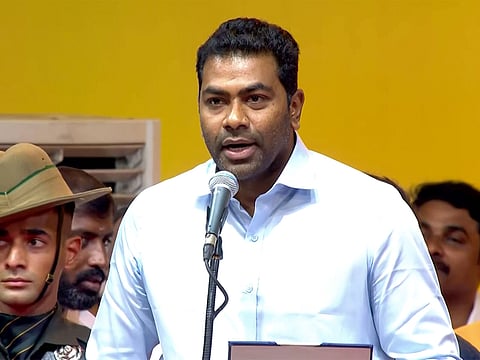

CHENNAI: Minister for Public Works and Sports Development Aadhav Arjuna on Friday said the Tamil Nadu government had undertaken sweeping reforms in the Public Works Department (PWD) and Highways Department to root out systemic corruption, eliminate ‘benami’ tenders and ensure transparency in project execution. The reforms, he said, had helped bring down project costs by up to 30 percent.
Addressing a press conference here, Arjuna said the era of tender manipulation and politically motivated contract allocations, which he alleged had prevailed for the past 15 to 20 years, had come to an end.
“With the system now open to transparent bidding, tenders are attracting bids that are 25 to 30 percent below the estimated costs. The massive financial leakage has been plugged, and the savings are going directly into the government treasury,” he said.
The Minister said several complaints relating to alleged irregularities under the previous regime had been referred to the Directorate of Vigilance and Anti-Corruption (DVAC) for investigation.
He cited an alleged large-scale road patchwork scam in the run-up to the previous Assembly elections, claiming that allocations for such works had increased sharply from the usual annual expenditure of around Rs 500 crore to between Rs 2,200 crore and Rs 2,500 crore.
“Works were allegedly divided into smaller packages worth Rs 10 lakh each to circumvent stringent tender procedures. This was a massive scam, and the DVAC is investigating it,” he said.
The anti-corruption measures, he added, had also extended to the department's internal administration. Transfers of employees, particularly those in lower-level engineering positions, had earlier allegedly involved bribes ranging from Rs 25 lakh to Rs 50 lakh. Such transfers were now being carried out transparently, without any financial demands, he said.
Taking aim at the previous administration for floating tenders without completing land acquisition or securing mandatory approvals, leading to prolonged delays, Arjuna announced a stringent protocol for infrastructure projects.
“Hereafter, no tender will be floated unless land acquisition is completed, the Detailed Project Report (DPR) is ready, and all necessary environmental, Directorate of Town and Country Planning (DTCP) and Chennai Metropolitan Development Authority (CMDA) clearances have been obtained.
“We cannot allow a project scheduled for completion in 36 months to drag on for eight years, with contractors holding government funds even when the required land is unavailable,” he said.
In a move to promote public participation and greater scrutiny, DPRs will henceforth be uploaded on government websites and opened for public review for five days before tenders are finalised.
The government is also planning a major shift in the design and construction of public buildings to make more efficient use of valuable urban land.
Arjuna said new government hospitals and collectorate buildings would make full use of the permissible Floor Space Index (FSI), moving away from the conventional low-rise structures.
“If private IT parks can have 20 floors and comfortably accommodate thousands of people, there is no reason why government buildings should be restricted to G+3 or G+4 structures. With the Chief Minister's approval, new buildings will have up to 14 floors and adhere to international architectural standards, with a design life of 75 years,” he said.
Outlining measures to improve road quality and provide relief to motorists, the Minister said the department had discontinued ad hoc road patchwork and introduced a five-year quality and maintenance guarantee for contractors executing road projects.
Contractors will also be required to mill and remove existing road layers before relaying roads. The measure is intended to prevent successive layers of resurfacing from raising road levels and causing rainwater to flow into adjoining houses, he said.
The government has also put in place stricter monitoring mechanisms for infrastructure projects, with six-month performance milestones.
“Any contractor who fails to meet the stipulated milestones will face immediate cancellation of the contract and blacklisting. There will be no political interference or pressure from our side. Contractors will be held accountable for delivering quality work within the stipulated time,” Arjuna said.
