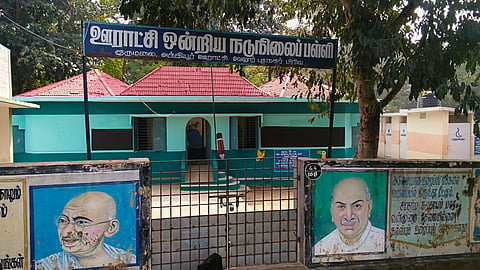

VELLORE: S Simbu, a Class 8 student from Kurumalai tribal hamlet in Vellore’s Anaicut taluk, is preparing to accompany his parents to work in a tea plantation in Kerala during the harvest season. He is unhappy that he will miss his friends and several months of lessons, but his parents insist on taking him along as they have no relatives who can look after the boy. “What if he falls sick? What if he gets bitten by a snake?” they ask.
More than 500 Malayali tribal families live in Kurumalai and nearby tribal hamlets, including Vellakalmedu, Nachimedu and Pallakollai — all located in Athiyur panchayat. From these four hamlets, 89 students attend the local Panchayat Union Middle School (PUMS), but at least 40 of them remain absent for around four to five months every year when their parents migrate for work. During the rest of the year, women cultivate custard apples and jackfruit, while some men travel downhill for daily wage work.
“Only if we go outside can we find jobs. It is very difficult for us to think about leaving our children behind and going to work. So we take them along when we move to other states for work,” said Vijayakumari M, whose daughter is a Class 7 student and whose son is in Class 1. She takes both kids to a coffee plantation in Karnataka when she goes for work in December. “If there is a hostel facility here itself up to Class 10, our children can stay there while we go to work,” she added.
Another parent said, “We did not study. At least our children should be able to study and get good jobs. They should not struggle like us in the future.”
Kurumalai PUMS Headmistress D Saraswathi said the prolonged absence affects students’ learning. “Around December, they leave with their parents and return only by March. How will we prepare them for the final examinations? Forget catching up with the missed syllabus; they return clueless about what they learnt five months ago,” she said, adding that a hostel would greatly benefit the students in the region.
Vikram Vinod Kumar, a social activist who accompanied residents to submit a petition to the collector, said seasonal migration continues to disrupt the education of generations of Malayali tribal children. He said a residential facility would ensure consistent access to education without separating them from their homeland.
At present, Vellore has two tribal welfare hostels — a boys’ hostel in Odugathur and a girls’ hostel in Peenjamandai — besides six Government Tribal Residential (GTR) schools. Hostel facilities in areas like Peenjamandai have helped parents continue working in nearby agricultural fields without taking their children along.
The residents have also sought jobs under the VB-G RAM G scheme or similar employment opportunities in Kurumalai. “If we have jobs here, we will not have to go elsewhere for work, and our children can attend school regularly,” said Revathi D, another villager.
An official from the Adi Dravidar and Tribal Welfare department said the petition would be forwarded to the Anaicut tahsildar for a survey to ascertain the school’s class-wise strength and other details. Based on the report, the department would send a proposal to the Directorate of Adi Dravidar Welfare for approval and funding.
“It is a feasible proposal as there are presently 89 students. The minimum strength required to establish a hostel is 55,” the official added.
Despite TNIE’s attempts, Collector P S Leela Alex was unavailable for comment.
