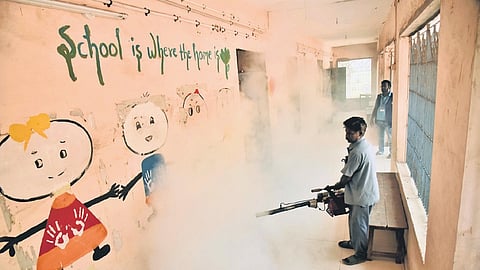

CHENNAI: The monsoon is in, and the buzz has gone up, literally!
Battling the surge in mosquitos in the last few weeks, the residents of the city have been urging the civic body to intensify fogging operations. The corporation has received 1,973 complaints related to the mosquito menace in the last three months, including 301 in the first 13 days of November.
In September, 985 mosquito-related complaints were received, which dropped to 687 in October. Official sources said though the number of complaints declined, the menace is expected to intensify over the next three months – November to January.
The residents strongly feel that fogging operations need to be intensified. Sandhya Vedullapalli of Anna Nagar said, “Fogging is carried out only after repeated complaints. After a week of follow-up, domestic breeding checkers visited our area a few days ago and carried out fogging. Despite this, the mosquito menace continues. The civic body should intensify anti-mosquito operations through door-to-door hand fogging to ensure better results.”
She added, “As far as I know, the GCC is also not spraying anti-larvicide along the Otteri Nullah canal nearby.” Similarly, R Rathika (26), a resident of Vijayanagar in Velachery, said the vehicle-mounted anti-mosquito fogging was last carried out in her area around three weeks ago.
North Chennai residents reported similar issues. “The menace starts in the morning and intensifies in the evening. Buying bats and mosquito sprays has become an additional expense for us,” a petrol bunk staff from Tollgate said.
The civic body has deployed 3,703 personnel in the mosquito-control activities, with each worker inspecting 80 to 100 households daily. Nearly 372 locations across Chennai have been identified as hotspots and are kept under regular monitoring. A DBC worker told TNIE, “It’s true that the mosquito population has increased. But it is also true that we are carrying out more control activities than previous years.”
Mosquito development tends to be faster during winter, while their lifespan also increases from the usual 21 days to around 29 days. This, in turn, could increase the number of mosquito generations from four to five batches a month, adding to the menace, an official from the GCC’s vector control department said.
Dengue cases drop
However, dengue cases have reportedly declined recently, the official said and added the city recorded 1,260 dengue cases in September and 1,174 in October, which dropped sharply to 186 in November (till 13th).
“This suggests that the reported increase in mosquito menace is not necessarily linked to dengue-transmitting mosquitoes but could largely be due to Culex mosquitoes - commonly found in stagnant and polluted water,” the official said.
Green pesticides
The official said the GCC had conducted a pilot study ahead of the monsoon, using drones to spray a green pesticide. “To control Culex mosquitoes, we will focus on drone-based spraying on 240 km of waterways in Chennai, along with fogging operations in stormwater drains,” he said.
Complaints received by Chennai Corpn
So far in 2026: 6,340
September: 985
October: 687
November (till 13th): 301
Dengue cases
registered: over 4,000
September: 1,260
October: 1,174
November (till 13th): 186
Tackling the menace
372 mosquito hotspots being identified and monitored
3,703 personnel deployed, with each worker inspecting 80 to 100 households per day
240 km of waterways targeted for drone spraying, and over 3,000 km of stormwater drains will be subjected to fogging operations
