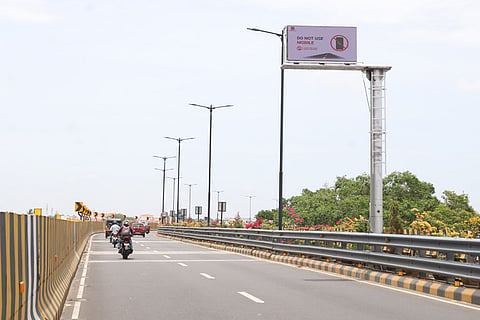

COIMBATORE: The state highways department has asked the Coimbatore city police to take over the AI-powered speed monitoring system installed on the GD Naidu Flyover, following a prolonged delay in commissioning the project. The police, meanwhile, have sought funds from the district administration under the road safety fund to meet the recurring expenditure towards electricity and maintenance.
Officials installed as many as 44 AI-powered cameras and 16 display walls at various locations along the 10.1-km-long flyover to monitor traffic violations, particularly overspeeding. However, the system has remained in the trial phase for more than four months, despite the flyover being opened to traffic. During this period, officials have noticed an increase in traffic violations, especially overspeeding.
Police officials said that enforcing speed restrictions on the flyover had become difficult in the absence of a fully-operational monitoring system. The flyover allows vehicles to travel uninterrupted across its entire stretch, prompting many motorists to accelerate beyond the prescribed speed limit. Following a series of accidents, the police had recommended that the highways department install speed-monitoring cameras.
Subsequently, the department installed AI-powered cameras and initially indicated that the system would be handed over to the police after the completion of the installation and trial process. However, the department has now requested the police to take over its operation and maintenance.
A private firm roped in to install the AI-powered cameras completed the agreement in October, leading to further delays. Following this, the highways department approached the police to operate and maintain the system. Police technical teams have now started fine-tuning the cameras and associated systems, a police officer said.
The officer said that the maximum permissible speed on the flyover was fixed at 60 kmph, while the limit on city roads was 40 kmph. The police were currently fine-tuning the system to ensure that it functioned according to the prescribed speed limit.
The police were also not considering replacing the AI-powered cameras with Automatic Number Plate Recognition (ANPR) cameras, as the latter would require integration with the backend software managed by the National Informatics Centre (NIC), including the Vahan Vehicle Registry and the e-Challan system. Any changes to the integration would require coordination with the NIC, the officer said, adding that the existing AI-powered camera system was nearing the completion of its trial run. The remaining installation and technical works would be carried out by the police technical teams and also with private support.
However, the recurring expenditure towards electricity consumption and maintenance of the equipment could pose a challenge once the system is fully taken over. Hence, the police have requested the district administration to allocate funds from the road safety fund to meet these expenses.
