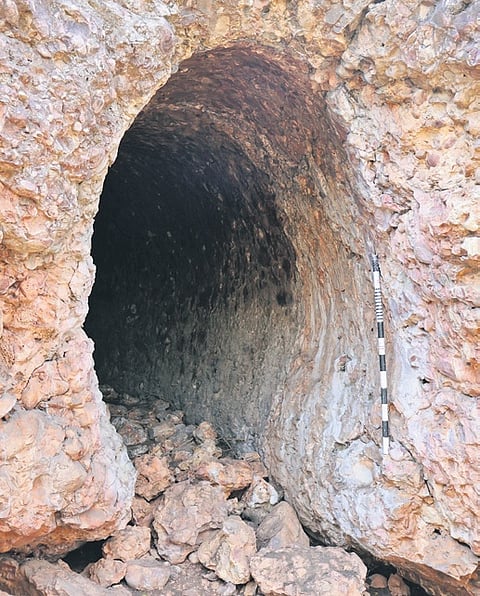

CHENNAI: Several significant archaeological findings — including a tunnel-like cave that appears to have been deliberately cut and shaped by humans — were recently discovered at the Gudiyam Caves in Tiruvallur district, which is known for its prehistoric natural rock formations.
Dr P Kumaraguru, former Director of the Geological Survey of India, and B Gowtham, Associate Professor and Head of the Department of Geology at Government Arts College, Coimbatore, opined that the cave differs from natural formations. Dr P Kumaraguru said the Gudiyam Caves were natural formations, with archaeological evidence indicating human activity dating back to the Stone Age.
The findings emerged from an ongoing archaeological documentation project undertaken by Yaakkai Charitable Trust in collaboration with the Tamil Nadu Forest Department. The team has also documented stone tools, rock cupules, inscriptions and other historical remains.
The tunnel-like structure, locally known as Vavaal Cave (Bat Cave), is 11.87 metres long, with an entrance measuring 3.22 metres in height and 2.22 metres in width. Its planned and refined form, levelled interior and absence of rough surfaces, mineral deposits and rock-fall features normally found in natural caves suggest that it was deliberately cut and shaped, said Kumaravel Ramasamy, secretary of Yaakkai Trust and one of the researchers.
“While the Gudiyam Caves are naturally formed, the newly identified Vavaal Cave shows signs of human intervention. The rock paintings documented in the region are also similar to those found at other prehistoric sites in Tamil Nadu,” Dr Kumaraguru said.
Another significant finding is the documentation of ancient rock paintings in red ochre, white and black. The paintings include ancient symbols, geometric motifs and human figures. At Kuralchavadu Sunai cave, a painting was identified on the upper wall, 7.08 metres above ground level. Paintings were also documented at Pasumaadu Parai and Kannithoppu caves.
The survey has identified rock cupules, or cup-shaped depressions on rock surfaces, at five locations. Eighteen such markings of varying sizes were found together near a spring on the route to Pasumaadu Parai cave. Studies of similar markings suggest possible associations with ancient counting practices, mapping or ritual activities. The team has documented caves used by prehistoric communities at 18 locations out of 40 surveyed. Stone tools, flakes and partly broken stone-tool cores have also been recorded.
The project follows an MoU signed in June 2026 between the State Forest Research and Education Institute, Dharmapuri Forest Nursery Division and Yaakkai Charitable Trust. Researchers Kumaravel Ramasamy and Sudhakar Nalliyappan are documenting the archaeological sites using scientific methods and digital archival techniques.
