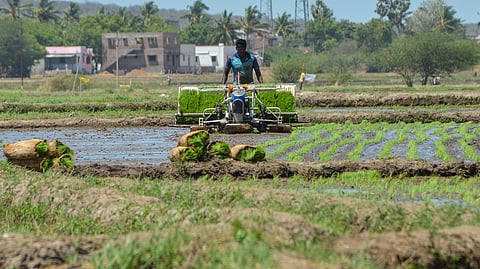

KANNIYAKUMARI: The number of paddy transplantation workers has been decreasing rapidly in Kanniyakumari district. The decline has forced farmers to opt for machine transplanting of paddy seedlings, instead of the traditional manual transplanting of Kumbapoo paddy cultivation, which has begun across the district.
Farmers said women were mostly involved in the transplantation of seedlings, but the number of these workers has considerably decreased of late.
A farmer, M Muthum Perumal from Thazhakudy, said: "The new generation is not interested in the traditional transplantation work. Only women experienced in this work take up the work. With labour shortage, farmers opt for machine transplanting."
Trained people from Mayiladuthurai have come here for the work. Around 80 percent of transplanting was done by machines in and around Thazhakudi, he added.
Favoring traditional method, Chenbagaramanputhoor farmers association president N Rakkisamuthu said that while Rs 5,250 had to be spent for traditional transplantation per acre, it was only Rs 4,500 for machine transplantation.
"But, we have to spend more money and effort in nursery preparation in case of machine transplantation," he noted.
Farmers rely on machine transplantation due to labour shortage, he added.
Farmer V Shanmugam also said the dwindling number of workers forced them to deploy machines.
However, he said some machine transplantation operators do not plant the seedlings correctly. "So we have to spend extra money for manual transplantation in the left-out areas," he said.
He noted that women workers favour non-agricultural work as the number of employment days in agriculture has decreased due to mechanisation.
Farmer K Chidambaram from Theroor said that machine transplantation was done in around 90% of paddy fields in the Theroor area.
Only a portion of paddy fields used the traditional practice due to issues with water draining, he noted.
An agriculture department officer said that the target Kumbapoo season paddy cultivation in the district was 5,650 hectares. These were mostly in Thovalai, Agastheeswaram and Kalkulam taluks.
