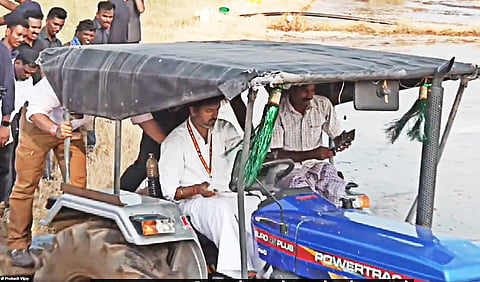

CHENNAI: TVK’s transition from a new-age political outfit built around its leader’s popularity to a conventional party became increasingly evident during the Madurantakam and Dharapuram bypolls, with the party adopting campaign methods that have long defined electoral politics in Tamil Nadu.
Both constituencies have substantial semi-urban and rural stretches. The change therefore went beyond the optics of Vijay driving a tractor or having tea at a roadside shop. It reflected the party’s attempt to translate the popularity of its leader into a political organisation capable of operating at the grassroots.
The shift was visible in the manner in which Chief Minister C Joseph Vijay had campaigned in the two constituencies. Unlike the largely centralised and high-tech campaign associated with the party’s emergence, Vijay had spent four days campaigning on the ground in the two constituencies, combining public meetings with hours-long roadshows and direct interaction with voters.
In Madurantakam, Vijay undertook a 45-km roadshow covering more than 30 villages. He stopped at a roadside tea shop, interacted with residents, drove a tractor through agricultural land and spoke to women working in the fields. In Dharapuram, he again took the roadshow route, covering around 40 km and making stops for public interaction and a temple visit.
While Vijay had largely been silent on the state’s political issues – leaving statements to ministers like Aadhav Arjuna and CTR Nirmal Kumar – he condemned DMK chief MK Stalin for the first time for his comments on TVK’s Dharapuram candidate P Sathyabama.
“The TVK is trying to cannibalise AIADMK, to take over its infrastructure and its second- and third-tier leaders, and bring its die-hard supporters into its fold. If the TVK has to position itself as the strongest anti-DMK force, it has to build a conventional party organisation,” said political analyst and writer R Kannan.
But the change in campaign strategy also reflects the geographical limitation of the party’s initial appeal, said political analyst and political science assistant professor Arun Kumar.
“In the April Assembly election, the party largely won only in urban pockets. So, its strategy of campaigning helped it only in places where satellite reach was high. To be a party that reaches every nook and cranny of the state, they have to get down to earth like any other party in the country,” Arun Kumar said.
“Considering Madurantakam and Dharapuram are heavily semi-urban and rural pockets, Vijay and the TVK had no other option but to adopt traditional party tactics,” he added. “Although initially the TVK was opposed to freebies, its election manifesto adopted Dravidian policies. The core nuances of the state cannot be changed, although a new party has come to power. The TVK’s arrival in power may not necessarily alter the basic political culture of Tamil Nadu,” he said.
