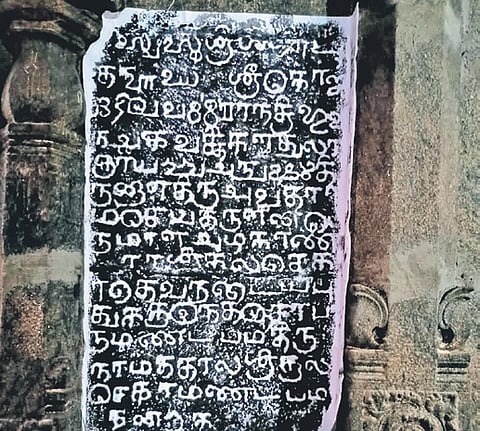

CHENNAI: The epigraphy division of the Archaeological Survey of India (ASI) has begun documenting and recopying inscriptions at the Palvanatheswar Shiva temple in Tenkasi district’s Karivalamvanthanallur village.
According to ASI, the temple is an important site of historical, architectural, and epigraphical significance. The ongoing work is aimed at documenting inscriptions and preserving their contents as part of the ASI’s wider efforts to digitise inscriptional records under the Bharat Shared Repository of Inscriptions (BharatSHRI) project. The inscription copying work started on Wednesday and it will continue for the next 15 days.
“We got information about inscriptions in this temple and accordingly our team visited it. They will visit significant places in and around the temple and other parts in the district to identify and copy similar ancient inscriptions, which will subsequently be deciphered and digitised,” ASI Director (Epigraphy) K Munirathnam Reddy told TNIE.
The ASI team has so far identified three inscriptions at the temple that had not previously been documented. According to ASI officials, the inscriptions record details of donations made to the temple.
“One of the inscriptions mentions a land grant made to the temple during the period of the local Pandyas. The discovery is expected to provide valuable information on the temple’s history as well as the administrative and socio-economic conditions of the period,” said an ASI official.
Under BharatSHRI, the ASI is creating a dedicated digital repository of inscription estampages. The repository will include information on the location, ruling king and dynasty, language and script, period, transcript and description of each inscription, helping researchers access and study India’s epigraphical heritage, said the official.
For the unversed, estampage is an epigraphy technique used to make an exact copy or impression of an immovable inscription (such as carvings on stone, rock faces, or temple walls) onto paper.
