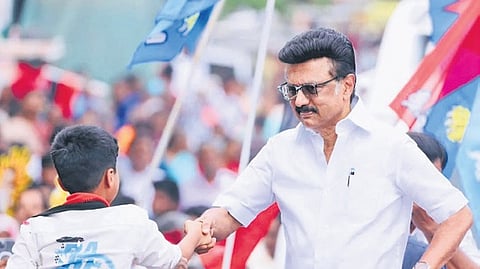

CHENNAI: After a decade of relying on professional political strategists and campaign consultants, the DMK appears to have returned to its organisational roots for bye-elections in Madurantakam (SC) and Dharapuram (SC) constituencies, putting the party machinery and its grassroots network at the centre of its campaign strategy.
After the 2014 Lok Sabha election, political parties in Tamil Nadu increasingly turned to professional election strategists. The DMK brought in Sunil Kanugolu for the 2016 Assembly election and later Prashant Kishor for the 2021 Assembly election.
For the 2024 Lok Sabha election, the party worked with its own strategy outfit, PEN, while for the 2026 Assembly election, it employed a combination of IPAC, political consultant Robbin Sharma and PEN for different aspects of its electoral campaign. However, for the two bypolls, the party relied substantially on its own organisational machinery, with booth-level polling data being used to identify electoral trends, voter preferences and areas requiring greater attention.
According to sources in the party, youth wing leaders and cadre were tasked with booth-level planning, analysing polling data and undertaking door-to-door campaigns. “With the 2026 poll data, we went to every street in every village. Apart from the traditional voters, we also spoke to youngsters to get a sense of their expectations and tried to get their support as well,” a youth wing functionary, who went for the campaign, told TNIE. Political analyst Arun Kumar said the move could be one of DMK’s biggest strengths, given the depth of its organisational network.
“External strategists can provide data, campaign ideas and a broader perspective, but implementing an electoral strategy at the grassroots ultimately depends on the party machinery. The DMK has a very deep network extending from the district level to the booth level, and this gives it an advantage, particularly in a bye-election where the campaign is more localised,” he said.
“Unlike a state-wide election, a bypoll is fought in a very limited geographical area. Every booth matters and the party can closely monitor individual voters and local issues. The cadre can use their existing relationships with voters and work constituency by constituency, booth by booth. That kind of micro-management is difficult to replicate entirely through an external agency,” he added.
However, political analyst Kannan said the emergence of TVK has altered the political dynamics confronting the DMK. “Even if people forget the DMK, TVK is constantly mentioning the DMK. At the same time, the DMK is unable to figure out how to expand its traditional base,” he said.
The effectiveness of the DMK’s strategy will reflect in the bypoll results today.
