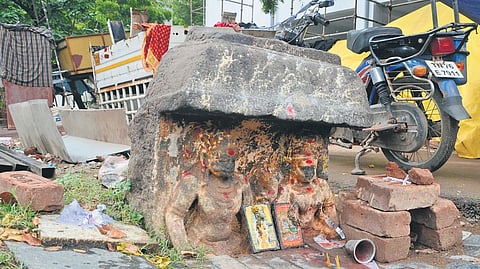

TENKASI: A centuries-old sati stone lies partly buried and neglected by the roadside near Tenkasi railway station, prompting calls for its preservation. Archaeology officials are considering moving it to the Courtallam museum or protecting and displaying it at the site.
Believed to date to the 16th or 17th century, the stone commemorates a man identified in its inscription as Ariyavan and his unnamed wife, who immolated herself on his funeral pyre.
Archaeology enthusiast V Narayanamoorthy told TNIE that the male figure is depicted wearing a thalai paagai (turban), with a twisted moustache and ornaments on his neck, arms, legs and shoulders. “The female figure is shown with her left leg folded and her right leg hanging down. She holds a flower in her right hand, while her left hand rests on her thigh. She also wears ornaments on her neck, arms and legs. Her left breast is damaged,” he said.
According to Narayanamoorthy, the inscription identifies the man as Ariyavan but does not name his wife, describing her instead as “the woman who did not part with her husband” (Kanavanai Piriyaathaal). He said the lettering suggested that the stone dated to the 16th century. “Two or three sati stones found at this location decades ago have gone missing. The archaeology department should at least move this surviving stone to a museum and safeguard it,” he said.
V Parthiban, another archaeology enthusiast and founder of Aatrupadai heritage group, also urged the government to safeguard the stone. “The earliest reference to sati stones is found in Sangam literature. The stones depicting a husband and wife in this manner, found in Tirunelveli, Tenkasi, Thoothukudi and Kanniyakumari districts, are unique and differ from those found in north Tamil Nadu,” he said.
Sakthivel, archaeology officer at the Courtallam museum, told TNIE that the department was taking steps to protect the stone from further damage. He suggested that it could date to the 17th century. “We are planning to seek permission from the railways to access the stone. We can either move it to the museum or construct a shed at the site and display it for public viewing,” he said.
T Kaleeswaran, archaeological officer, Tenkasi, said permission from the department’s headquarters was required to move the stone to a museum.
