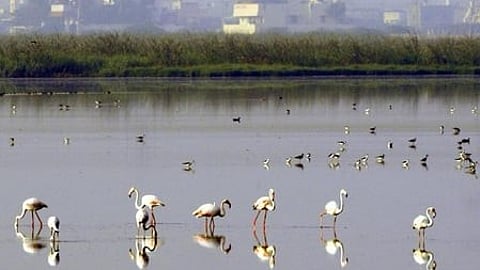

CHENNAI: Tamil Nadu’s wetlands authority has proposed allowing construction in parts of the buffer zone around Chennai’s Pallikaranai marsh, subject to restrictions that could protect the drainage channels that sustain the Ramsar-listed wetland, according to official sources.
Official sources told TNIE that the Tamil Nadu State Wetlands Authority, in its status report submitted to the Madras High Court, has stated that construction need not be prohibited across the entire zone of influence and can instead be regulated according to site-specific scientific and hydrological characteristics. The revised interim zone covers 128.19 hectares across 36 survey numbers identified as possibly affecting the marsh’s hydrology.
The proposal comes after objections from real estate developers, including CREDAI Chennai, Olympia Tech Park and Navin Housing and Properties, to the earlier demarcation drawn up following the Madras High Court’s August 4 order. The authority has not disclosed the extent of the changes made to the original boundary.
It is learnt that the authority received 23 representations from landowners, developers and others seeking the exclusion of privately owned patta land, reconsideration of specific survey parcels, recognition of existing buildings and development permissions, and a clearer distinction between the wetland boundary, its zone of influence and developed private land.
Following a further court order on September 7, officials met on September 30 to reconsider the proposed boundary. They examined historical Google Earth imagery to assess changes in water spread, low-lying areas, drainage channels, open land and built-up areas. Individual parcels were reassessed for their hydrological connectivity, drainage pathways, nearby wetlands, existing infrastructure and land use.
Sources said the authority observed that the exercise sought to address concerns over the inclusion of private and some government land while balancing conservation and development.
Pallikaranai village accounts for 23 of the 36 survey-number entries in the revised zone. The others are in Sholinganallur, Karapakkam, Injambakkam, Perumbakkam, Okkiyam Thoraipakkam and Perungudi. Two parcels in Perumbakkam fall in Chengalpattu district, while the remaining parcels are in Chennai district.
The proposed safeguards would prohibit the blocking or diversion of established inlet and outlet channels, natural drains and other water pathways.
Dumping solid waste and construction or demolition debris in drainage routes would also be barred, as would discharging untreated sewage, effluent or wastewater into watercourses connected to the wetland. Permanent alterations to established hydrological connections and industries classified as Red Category because of their high pollution potential would also be prohibited.
Any construction within the proposed zone would require a no-objection certificate from the district-level wetlands management committee.
The approach would make the preservation of water flows, rather than a blanket construction ban, the central regulatory test for the interim zone. The authority says the safeguards are intended to prevent development from disrupting water entering or leaving the marsh or damaging its ecological character.
The revised boundary remains provisional. The authority says the final zone of influence will be determined only after scientific and cadastral assessments and ground verification under the Wetlands (Conservation and Management) Rules, 2017, and the associated guidelines.
The report is to be placed before the High Court in about a dozen connected petitions, official sources said.
