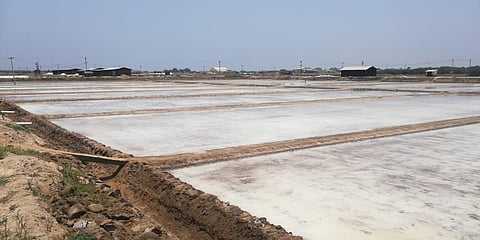

NAGAPATTINAM: Salt production in the Vedaranyam region has touched nearly 95% of the annual (February to October) target of 1.75 lakh tonnes, marking a five-year high, thanks to prolonged dry weather and intense heat. However, the record production has failed to translate into better earnings for salt producers, who say procurement prices have fallen by nearly half amid a sharp decline in the number of buyers.
The price crash has forced nearly 30% of small-scale salt producers to halt production, according to producers, who fear the situation could further undermine the region’s salt industry.
Salt production for the current season began as usual in January. With a weaker monsoon and rainfall remaining poor, the region experienced unusually intense heat over the past several months. Salt producers said the dry weather has allowed salt production to continue for a longer period and resulted in higher output. Last year, only around 40% of the normal target was achieved due to heavy rains.
The procurement price of salt, which was around Rs 1,000-Rs 1,200 a tonne at this time last year, has now fallen to around Rs 600-Rs 750. Producers said the cost of producing a tonne of salt is around Rs 600-750.
“With the selling price remaining low, the returns are becoming insufficient to cover production costs and could leave small producers in financial difficulty,” said V Senthil, secretary of the Small-Scale Salt Manufacturers’ Federation.
“Around 30% of the small-scale salt producers stopped production from mid-August as they were unable to bear the additional expenses amid the sharp decline in the number of buyers,” Senthil added.
Producers said the problem has been particularly difficult for small operators, who have less capacity to absorb losses or hold large quantities of unsold salt.
P Sundaramoorthy, a small-scale producer, said salt production has faced disruptions from natural factors in recent years, but the absence of rain this year has resulted in unusually high production. “If salt keeps on selling for even lower prices, we might face losses,” Sundaramoorthy added.
“Since the production is higher this year, buyers were able to get salt from Thoothukudi and other places with more accessibility,” Senthil said.
Salt is produced across around 3,000 acres in Agasthiyampalli, Kodiakkadu and Kadinelvayal by around 800 small-scale producers. The sector supports thousands of workers directly and indirectly in the region. Producers said the stoppage of production in some salt pans has not affected salt pan workers, as they are working in other pans as the production remains high. Although production has already reached most of the season’s target, work has continued in some salt pans because the weather remains favourable for production.
Around 60% of the salt produced is edible and 40% industrial. The salt is supplied to Andhra Pradesh, Karnataka, Kerala and various parts of TN.
With the number of buyers declining sharply and the market price remaining low, producers are now relying on the possibility of better prices later in the year. However, they remain uncertain whether the salt currently being stockpiled will fetch better returns during the monsoon.
