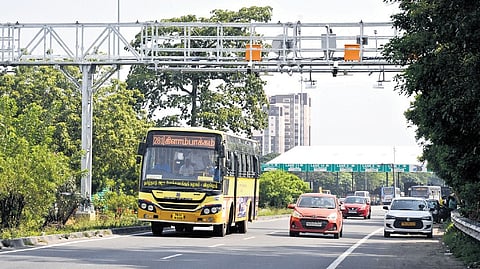

CHENNAI: Travel time for vehicles heading towards Tindivanam on the Chennai-Tiruchy National Highway, and towards Vellore and Bengaluru on the Chennai-Bengaluru Highway is set to come down by 10 to 15 minutes, with the National Highways Authority of India (NHAI) deciding to introduce a barrier-free toll collection system using Automatic Number Plate Recognition (ANPR) technology integrated with FASTag from the first week of October.
The NHAI has installed Multi-Lane Free Flow (MLFF) user fee collection systems near the Paranur, Nemili (Sriperumbudur) and Chennasamudram (Walajah) toll plazas, and has commenced trial operations.
Under the existing FASTag system, vehicles have to slow down or stop at toll booths, where a Radio Frequency Identification (RFID) device reads the FASTag and deducts the toll amount before the barrier is lifted. The MLFF system, however, will allow vehicles to pass through the toll point without stopping.
As part of the system, metal gantries covering the entire width of highways have been installed about 100 metres ahead of the toll plazas. The gantries, equipped with overhead walkways and railings, have been fitted with ANPR cameras, sensors, RFIDs and other supporting equipment. Mounted about 5.5 metres above the ground, the cameras can capture vehicle registration numbers even when vehicles are travelling at a speed of upto 150 kmph.
The ANPR cameras are capable of recording video footage from up to 40 metres away, with a five-second recording window. RFID readers and other supporting devices have also been installed to identify vehicles at least 300 metres before they reach the toll collection point. The ANPR cameras will cover the main carriageway, service roads and other entry and exit points on either side of the highways.
“Currently, it takes around five minutes to 10 minutes to cross these toll plazas during peak hours. The waiting time increases further during festival and holiday seasons. The halt also affects the speed and smooth flow of traffic. We have commenced the trials and have sought access from the state transport department to link vehicle registration numbers with their respective categories,” a senior NHAI official said.
He said the linkage was necessary to avoid confusion in identifying different categories of vehicles, particularly trucks running with car numbers.
“The integration is expected to be completed within a week. Following successful trials, the barriers at Paranur and the other two toll plazas will be removed, allowing vehicles to travel directly through the toll points mostly from the first week of October,” the official said. In case of any discrepancy during the recognition of a vehicle number plate, a challan will be generated and sent to the vehicle owner.
The two national highways each handle around 75,000 passenger car units (PCUs) a day and are among the most congested highway stretches in the country.
After the launch of the MLFF system, the NHAI will assess various factors, including toll revenue collection, accident rates and travel time between toll plazas. Based on the findings, the system may be expanded to more toll plazas across the country.
