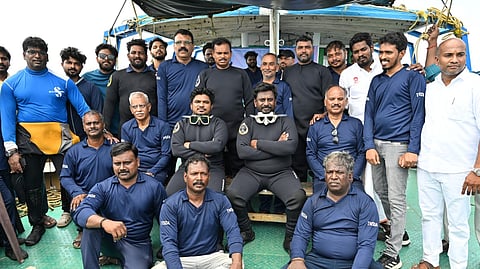

MAYILADUTHURAI: The Tamil Nadu State Department of Archaeology (TNSDA), in collaboration with the Indian Maritime University, on Sunday commenced underwater excavation off the Poompuhar coast to search for submerged structures and evidence linked to the ancient port city of Kaveripoompattinam. Minister for Archaeology A Rajmohan inaugurated the excavation along with Director of Archaeology V P Jayaseelan.
The exploration will be conducted about 2km offshore across approximately 250 sq km, at depths ranging from two to 60 metres, and will continue till September 23. The excavation team comprises up to 10 professional divers and archaeologists-cum-divers, including TNSDA Joint Director Dr Yatish Kumar, Archaeology Officer K Vasanthakumar, and archaeologists Barat Kumar and Kaleeshvaran. The team also includes TNSDA Joint Director Dr S Sivanandam (retd), GIS specialist Professor Dr Muthusankar, and Professor Sivakolundhu from the Indian Maritime University.
Joint Director Yatish Kumar told TNIE that side-scan sonar and echosounders would be used to identify anomalies on the seabed, following which divers would excavate the locations.
The excavation aims to establish the extent of the ancient port and associated structures, identify possible shipwrecks, study changes in sea levels and river courses, and understand Poompuhar’s role in ancient international maritime trade.
Preliminary studies were conducted in February 2025, followed by underwater surveys in September 2025 and diving operations in March 2026. Pottery fragments appearing to be of TN and foreign origin found during the surveys indicate a possibly submerged habitation. An elliptical structure was also found near a previously identified U-shaped structure, along with other structures buried in the seabed and a possible shipwreck.
Sunken past
Poompuhar finds mention in Sangam and post-Sangam literature, with Manimegalai detailing its submergence. Excavations since the 1960s have unearthed wharfs, a fourth-century BCE wooden structure, Buddhist remains, amphora, rouletted ware, Sri Lankan pottery and a Roman coin, indicating extensive trade links. Underwater explorations in 1981-82 identified a submerged ship and an 85-metre U-shaped stone structure at a depth of 23 metres, along with pottery and ring-well remains.
