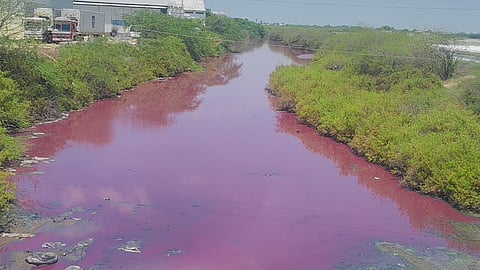

THOOTHUKUDI: A jungle stream at Gomezpuram in Mapilaiyoorani village has turned ink allegedly due to the discharge of untreated effluents from seafood companies.
The stream, Periyapallam Odai, flows from Ottapidaram and drains into the Gulf of Mannar.
Five seafood processing companies located along the southern bank of the Odai on the Tharuvaikulam road are involved in cleaning fishes, shrimps, prawns, crabs, squids and other marine species for export.
The process itself is water intensive and generates enormous waste water. Also the processing units use preservatives and anti-bacterial agents to preserve the marine species prior to export. It is alleged that the seafood processing companies discharge the waste waters into the Periyapallam Odai without treating them.
Sources said that sodium sulphite, an antibacterial agent used in fish processing companies, have been released into the waterbody, without being treated. The sodium sulphite could react with the water and turn it pinkish due to organic-sulfonate reactions, said an expert.
Experts added that the untreated wastes of seafood companies could deoxygenate the water, thus adversely affecting the water ecosystem, and killing any water species. It can also contaminate groundwater sources, he said.
When asked, the seafood companies defended that the concentrated brine solution drained from the saltpans located on the north bank of the stream might have triggered the discolouration.
The Thoothukudi district administration had sealed these five seafood processing companies in 2022 for releasing untreated effluents into the waterbody, and had mandated the installation of Effluent Treatment Plant (ETP).
TNPCB officials said that the companies were allowed to reopen following installation of the ETP with Zero Liquid Discharge (ZLD) so that the wastewater are reused. It is not clear that the companies discharged the wastewater directly into the waterbody.
Speaking to TNIE, a senior official from TNPCB, said that the colour change might have triggered bacterial growth which provides pink colour. The waterbody is stagnant as a large amount of seasand has blocked its flow into the sea during the tides. However, water samples have been collected for proper analysis, he said.
