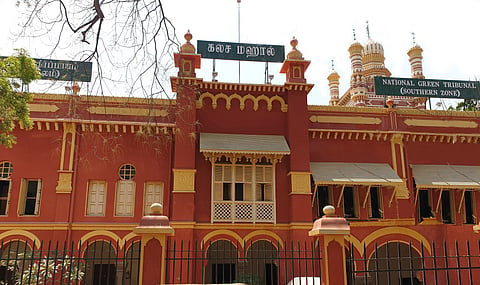

CHENNAI: The southern bench of National Green Tribunal (NGT) has made it mandatory for authorities to obtain clearance from the Tamil Nadu State Coastal Zone Management Authority (TNSCZMA) before permitting idol immersion at coastal locations, effectively ruling out immersion at sites falling under CRZ-IA (ecologically sensitive area) without such clearance from this year.
The order was passed on Thursday, but was uploaded only on Friday, after the tribunal examined arrangements being made across Tamil Nadu for Vinayagar Chaturthi immersion on September 20. The case relates to concerns over pollution of water bodies, rivers and the sea caused by idol immersion and compliance with its earlier directions issued in January 2024.
The tribunal specifically observed that, as far as immersion along the coastline was concerned, the authorities had to obtain CRZ clearance from the TNSCZMA. It made it clear that mere participation of TNSCZMA officials in meetings convened by the Greater Chennai Corporation (GCC) would not amount to clearance.
“Clearance from the TNSCZMA is mandatory,” the bench said, noting that the authority was responsible for management and conservation of marine and coastal ecosystems, development in coastal areas, livelihood security, sustainable development and coastal communities.
The direction has implications for several immersion sites identified by the State in Chennai, including Pattinapakkam and Neelankarai and other coastal districts. The tribunal said clearance had to be obtained particularly for sites in coastal towns, including those in Pudukkottai and Ramanathapuram districts.
The issue came up after the GCC identified immersion locations in the city. Its reports initially listed Pattinapakkam, Thiruvottiyur, Kasimedu and Palavakkam, with subsequent arrangements identifying Sreenivasapuram at Pattinapakkam, fishing harbour at Kasimedu, two locations at Thiruvottiyur, Palkalai Nagar at Neelankarai and Ramakrishna Nagar at Ennore. Idol height was restricted to 10 feet.
The tribunal had already noted that Pattinapakkam and Neelankarai fall within the CRZ-IA area. The GCC subsequently held meetings with the Chennai district collector, police commissioner, TNSCZMA, Tamil Nadu Pollution Control Board and other officials to discuss the practical difficulties of excluding the two locations and diverting idols to northern sites.
The GCC told the tribunal that shifting all idols from Pattinapakkam and Neelankarai would increase vehicle travel distances, procession routes, traffic-regulation points and police deployment requirements. It also apprehended greater concentration of vehicles and processions at Kasimedu, Thiruvottiyur and Ennore, putting additional pressure on entry and exit points, holding areas, emergency access, rescue arrangements and post-immersion cleaning.
As a compromise, 450 idols proposed for immersion at Palavakkam were to be diverted to Kovalam, while 250 idols proposed for Pattinapakkam were to be diverted to Ennore. The GCC sought permission to retain Pattinapakkam and Neelankarai for the current year with restricted numbers, while indicating that they would be excluded from the following year.
However, the tribunal stressed that environmental regulations could not be bypassed on account of administrative or logistical difficulties. It said the State’s affidavit was still awaited and directed that the order be strictly followed for this year’s immersion.
In its undertaking filed before the tribunal on Friday, the State said that in future it would begin planning and coordination for idol immersion well in advance, as far as practicable at least six months before the festival. It also undertook to consult the TNSCZMA, TNPCB, police and other authorities on permissible sites, eco-sensitive areas and coastal restrictions, artificial temporary ponds, idol size and numbers, traffic and public safety, and waste management.
The State further undertook to comply with the tribunal’s 2024 order and CPCB guidelines and examine artificial temporary ponds or tanks, with safeguards for handling polluted water and solid waste, before proposing the use of natural water bodies.
