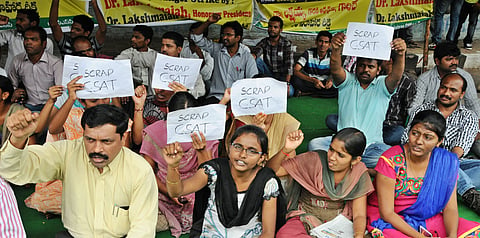

HYDERABAD: In a bid to pacify the agitating students from Hindi-speaking states, the Union government’s decision to partially tweak the Civil Services aptitude paper has only compounded the issue. The move, aspirants say, has resulted in providing undue advantage to Hindi medium students and would flare up a Hindi versus non-Hindi tension in the country.
The government’s idea to exclude English comprehension part of the CSAT paper in final gradation while retaining the paper has found dissonance in the city. In stiff opposition to the government proposal, scores of aspirants in the city held a sitin here on Tuesday and demanded scrapping of CSAT altogether or hold the exam in all 22 recognised national languages.
After Delhi, Hyderabad boasts of drawing the highest number of aspirants from across the country for coaching classes in the city. In this CSAT pattern, the cut-off marks of aptitude paper (paper II) are much higher than of that of general studies (paper I) which is naturally advantageous to students from technical background, feels Y Obulesh who had already made four unsuccessful attempts to get into All-India Services. “The two prelims papers have a maximum of 400 marks with 200 marks each. For instance in 2013, the cutoff marks for aptitude paper was 70 out of 200 marks, while it was much lower in GS paper which was only 30 marks.
For a student from technical background, the aptitude paper is such that they can score full marks; in fact it had happened with many students. But in GS paper that is not the case. In any situation the maximum marks one can score is only 100. So where is the levelplaying field?” he asks amid the sloganeering by other aspirants. Besides, he points out to the Nigvekar Committee report (2012), which the Union Public Service Commission itself had constituted, which confirms that more than 70 per cent of rural students are being eliminated at the prelims level due to the introduction of the CSAT exam.
Another aspirant Krishna Kishore says the government’s decision is very premature to retain the CSAT paper as it is while excluding the comprehension part in final gradation alone. Although, UPSC charges no application fee from SC/ ST, disabled and other disadvantaged candidates, CSAT is a discouragement for such students, he adds.
POLITICAL FACTORS AT PLAY
The way in which civil service aspirants have moved themselves by going into streets make them unfit for the services. They require certain application of mind and ability to analyse. In a country with 29 states and so many languages, where is the commonality without a language like English as a means of expression? Later, they will demand the entire examination in regional language and in such a situation, how do we say that the evaluator also from the same region does not show any bias?
Centre’s decision to not consider eight to nine questions of English comprehension in CSAT gradation will only accentuate administrators’ trend of narrowing down thought process leading to sectarian outlook. The whole controversy, more than anxiety of aspirants, is that certain political factors trying to embarrass the government. In our times, officers mostly came from humanities background.
We had a broader perspective in dealing with issues. Now, most of them come from science backgrounds. They are trained to focus on a concentrated area and come up with specific solutions. Civil services is all about different skill sets. Officers who were given different state cadres used to learn languages and culture to acquaint themselves with respective state.
If today one person does not want English in the exam, why would he want to learn other languages if required? In the past, exam patterns could test more than the aspirant’s academic knowledge. Frequent tinkering with the system is not good and if required, it should be done methodically which does not seem to be the case here. — VK Srinivasan, 1963 batch, economist and former Special Chief Secretary, AP
MONOPOLY IS UNACCEPTABLE
Hindi translation for English comprehension passages in paper 1 of preliminary exams was introduced in 2011. That itself is discriminatory towards aspirants from other regions. If that translation was too mechanical, they could have done with a personal approach in it instead of completely ignoring these questions in final gradation. In 2013, the government has already relaxed the system by removing English paper from the gradation and by it only a qualifying paper.
Preliminary exams are meant to be for elimination of candidates. If things are relaxed here, how are we going to choose from the available. Students from southern states do better when it comes to English comprehension. Now, they lose on some easy marks which would have helped them qualify. Most of the aspirants are not able to understand anything in English.
Even if regional languages were to be promoted, where are the reference textbooks available in all regional languages? They would have to still learn from English books and write in regional language then. It should be either all English or English plus all regional languages and thereby leaving no monopoly of certain language. — Uppada Subramanyam, former Vice- Chairman, Tirupati Urban Development Authority, and presently chief consultant, AP Study Circle
THE SYSTEM IS FLAWED
CSAThas been structured to achieve certain standards of excellence. But, not everyone has access to such required education. It is always the better off who gets the advantage. There are inequities but there should be some level-playing field. UPSC is justified in trying to get the best people. But can these qualities be determined by tests? I do not think so.
More of understanding and empathy is required than geography and biology. I feel the entire system is flawed. There must be a screening test with emphasis on social understanding, moral values, commitment etc because that is what will tell their real character. With such an emphasis, I do not think language will continue to be a barrier. People who come to services today are those who mug best and have different motivations. And, I do not think students should have protested.
They cannot keep reducing the denominators of standards. Knowing English does not make one the best candidate but English continues to be the link language. Even Chinese had to excel in English to compete globally. Above all, language requirements are either essential or desirable. The system would want the best and most flexible. One has to compete at the highest level and doing so, one cannot expect equity in the test. — K Sujatha Rao, 1974 batch, former Union Secretary, Ministry of Health and Family Welfare.
LONG-LASTING SOLUTION IS the KEY
The present CSAT is inclined towards testing the management and mathematical abilities. Candidates from various fields approach it in different ways. What a Civil Servant needs is basic administrative skills with a concern towards the society.
Yes, fears of regional language candidates are justified and genuine. However, the real qualifications are integrity and sympathy towards poor in facilitating government interventions. In fact, united AP has produced some of the finest Civil Servants: SR Shankaran( Economics), PS Krishnan( Literature) and others and they came from different backgrounds. Hence, the agitation should provide a long-lasting solution for aspirants from diverse backgrounds. — Kaki Madhava Rao, former Chief Secretary, united AP
Diversionary Tactics Do Not Bode
Well The problem with CSAT is that nearly 70 per cent students from rural backgrounds who without proficiency in English are being barred from IAS. If the government really wants to treat all candidates equally, let the paper be in English alone or in all 22 national languages. Otherwise, it will leave Hindi students with an undue advantage.
Some people insist that since Hindi is national language it has to stay. But we regard 22 Indian languages as national languages also. The language issue is diverting the attention from the actual problem of incorporating technical subjects which is affecting students from non-technical backgrounds. The govt should allow exam on August 24 as further delay will leave little preparation time for students selected for Mains. — Prof KS Chalam, former member, Union Public Service Commission
