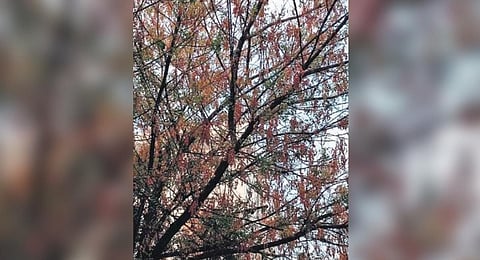

HYDERABAD: It has been more than three years now since the tea mosquito bug infestation, followed by a fungal attack has been found in the neem trees which caused dieback disease. The phenomenon which has been recurring year after year has been causing distress in the neem trees in the two Telugu States.
The branches of the affected trees turn lifeless but the trees used to recoup after fresh inflorescence after Ugadi. However, this year due to the rains in March, the infestation has aggravated, resulting in the loss of inflorescence and consequential loss of yield in the neem seeds.
According to experts, the neem trees could experience a yield loss ranging from 50 to 80 per cent, which could have a significant impact on the market for neem products. Industries relying on neem products, such as neem cakes, neem oil, neem coatings made from neem flowers for coating subsidised urea, soaps and cosmetics, to name a few, may face adverse effects due to this loss in yield.
The need to contain spread
Scientists warn that India would have to import neem-based raw materials from other countries where it is grown, if the infestation which is presently restricted to some States is not controlled, and especially if it becomes a nationwide issue.
According to Santosh Rao, a Telangana-based agri-input entrepreneur, the industry has already started witnessing a gap between the demand for raw materials and the supply of neem-based products in the market, which has shot up the prices of various products which are exclusively used in agriculture.
For example, there are various liquid formulations of neem oil which are available in different concentrations. Rao says that the retail price of a medium formulation per litre has increased by `150 in the market.
Companies source raw materials in two ways. One is by engaging the farmers to collect the material and sell it to agents, who deliver the material to the companies. The other method being followed by companies is growing neem plantations from where they directly harvest the raw material. Either way, the natural farming goals of the governments may have to wait longer to be realised.
Presently, there are institutions like the Forest College and Research Institute (FCRI), Professor Jayashankar Telangana State Agricultural University (PJTSAU), Indian Institute of Chemical Technology and Jadcherla Government Degree College, which have been doing research on mitigating the disease.
B Jagadeesh Kumar, Assistant Professor, Department of Natural Resource Management, FCRI, who is heading one such research study, tells TNIE that though the pathogen ‘Phomopsis azadirachtae’ causing the disease has been identified and plant management/mitigation methods have been suggested, it is practically difficult to treat the neem trees which are spread across the State.“As the pathogen is airborne and though its spread may be slow, once it reaches an area populated by neem trees its spread will be drastic,” Jagadeesh observes.
However, in the villages farmers may take care of the trees in their backyard or their fields, but still many trees growing in government lands and hills may not find someone to treat them.“Earlier, the disease used to appear only in June-July. But it is the first time this year that soon after fresh shoots and flowering during February and March, due to unseasonal rains the dieback disease appeared again on the recovered trees,” observes M Padmaiah, former principal scientist, India Institute of Oil Seed and Research and ICAR. “A national-level collaborative project on a war footing is badly needed if the spread of the disease hsa to be mitigated,” Padmaiah stresses.