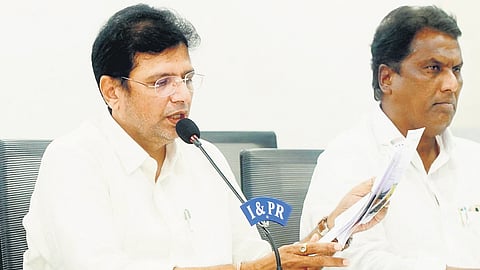

HYDERABAD: Lambasting the BRS leaders for misleading the people, IT & Industries Minister D Sridhar Babu on Tuesday said that the Musi Riverfront Development Project was started by the pink party when it was in power.
Addressing the media at the Secretariat, the minister said: “It was the previous BRS government which started the project. It also issued instructions to officials to demolish all structures built on buffer zone and FTL of Musi river. But now the BRS leaders are making statements that are contradictory to the decisions taken by their government.”
During the press conference, Sridhar Babu also presented copies of the GOs issued by the BRS government as well as minutes of the meetings related to the Musi development.
“In 2017, GO No 90 was issued, creating the Musi Riverfront Development Corporation. Who and which party was in power in 2017? The previous BRS government also appointed a chairman to the corporation,” he said.
“In 2018, a meeting was held for chalking out on action plan. That meeting discussed removal of encroachments and illegal constructions, rehabilitation and eviction plan and also fixing of boundaries and buffer zone limits,” he added.
Stating that the then municipal administration minister KT Rama Rao held a series of meeting on Musi project between 2018 to 2022, Sridhar Babu said: “In June 2020, KTR also instructed the district collector to fix the boundary and prepare the master plan. He also instructed officials to take forward the project on a war footing. He instructed officials to demolish all structures in buffer zone and FTL of Musi river. In fact, the BRS government had identified 8,480 such structures in Musi catchment area.”
The minister also said that the BRS government issued GO 7 in 2016, according to which the riverbed boundary and buffer zone limit as set at 50 metres.
“The Congress government did not change that buffer zone limit. We are going forward as per the GO issued by the BRS government,” he said and added that the BRS leaders were trying to mislead the people.
“If what you do is correct, then is it wrong if we do the same thing? If BRS gives any suggestions in resolving the problems, we are ready to listen. But I suggest that the BRS refrain from misleading the people with false statements,” he added.
Sridhar Babu said that people were suffering due to floods in Musi and that is why the government wants to develop the river.
Yaskhi vows to move court if govt ‘unjustly’ carries out demolitions
TPCC campaign committee chairman Madhu Yaskhi Goud on Tuesday assured several families residing on the banks of Musi river that Congress high command would intervene if injustice is meted out to them. He said that if the state government “unjustly” goes ahead with demolitions, he would file cases in the court of law, and would personally appear for them in the capacity of a lawyer. He, however, said that Chief Minister A Revanth Reddy had taken up the Musi development project in the best interest of the people. “The Congress government will not demolish any house illegally. Lead happy lives with your families. This is my guarantee,” Yaskhi told the residents of Kothapet. He also pointed out that the officials are not stating which year’s boundaries of Musi they are going to consider to declare FTL and buffer zone. He also said that if the state government demolishes any residence, it has to give a compensation under Land Acquisition Act introduced by the then UPA government.
Survey lacks statutory authorisation, claims AIMIM
Alleging that the survey conducted by the Musi Riverfront Development Corporation lacked statutory authorisation and was hence “illegal”, the AIMIM has demanded a resurvey. An AIMIM delegation, led by Karwan MLA Kausar Mohiuddin, met MAUD Principal Secretary Dana Kishore on Tuesday and demanded a detailed report mentioning the date the survey was conducted, its legality, whether a preliminary or final notification was issued before the survey to define the full tank level (FTL) and buffer zone boundaries. The delegation also asked whether the survey was conducted with assistance from the Revenue, Irrigation and other relevant departments, and whether the boundaries established in 2003 were considered.