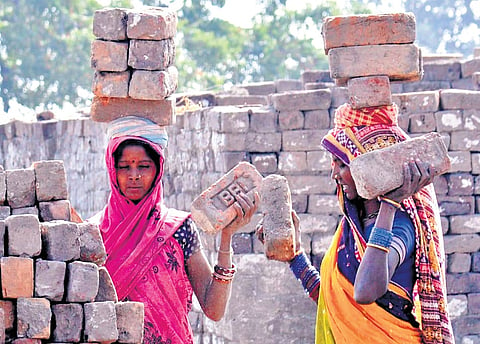

PEDDAPALLI: The rescue of 13 brick kiln workers from the Raghavapur area on the outskirts of Peddapalli on Friday has brought to light the grim reality of exploitation of the poor mostly from Odisha. These people from far off places come here to work in brick kilns in the hope of making some money, but end up in inhuman conditions.
Peddapalli district has become a hub for brick kiln operations, with over 100 kilns producing clay bricks. The area has become a breeding ground for labour exploitation, as revealed in a past Crime Investigation Department (CID) investigation.
In the last season, 146 workers from Odisha were rescued from various kilns in Peddapalli. According to CID reports, about 20,000 workers from Balangir, Bargarh, Khordha and Sambalpur districts in Odisha are employed in brick kilns in Peddapalli and Jagtial districts.
The Labour department has struggled to maintain records or enforce agreements between workers and owners of kilns.
District Collector Koya Sree Harsha has instructed officials to create awareness among brick kiln owners about the Labour Act, ensure compliance and provide adequate facilities for workers. “Most of these labourers come from Odisha,” said Peddapalli tahsildar Raj Kumar.
As the season is set to begin in November, authorities have focused on the need to monitor these kilns, citing frequent cases of physical and sexual harassment of labourers by kiln owners.

‘Agents bypass regulations’
Sources said that labour agents reportedly exploit the unorganised nature of this sector, circumventing regulations in the Inter-State Migrant Workmen Act, 1979, which mandates registration and restricts the number of labourers an agent can legally transport.
However, the Act is routinely flouted, with agents trafficking large numbers of workers beyond the legal limit. As there is limited supervision because of lack of manpower in government departments, these violations go unchecked, which allows traffickers to exploit workers with impunity, the sources pointed out.
Earlier, Phillips Isidore, convener of the Coalition Against Human Trafficking, Bonded Labour and Child Labour (CAHBC) from Odisha, said the recently recused 13 labourers were subjected to routine beatings, denied wages and had their mobile phones confiscated to prevent them from contacting their families.
Entire families — women, children and men — live at these kilns, facing serious health and safety hazards. Many labourers bring their families, including pregnant women and children, to help them.
Women mould bricks, children assist them in drying and men handle baking. This often leads to children being pulled out of school and pregnant women left without medical care or nutritional support, with some being forced to deliver on the kiln premises.
Way forward
To improve the condition of these hapless people, Odisha-based NGOs have recommended conducting surprise raids on kilns and questioning of workers privately, without employers or their representatives being present, about their working conditions.
Such measures, they say, will encourage labourers to report abuses openly.
Experts said that one of the most crucial steps to address this issue is the revival of Vigilance Committees, as mandated under the Bonded Labour System (Abolition) Act, 1976.
Headed by the district collector, these committees are tasked with conducting regular inspections of high-risk industries, including brick kilns. The committees are responsible for monitoring and addressing bonded labour practices within their jurisdiction, playing a key role in safeguarding workers’ rights, they added.