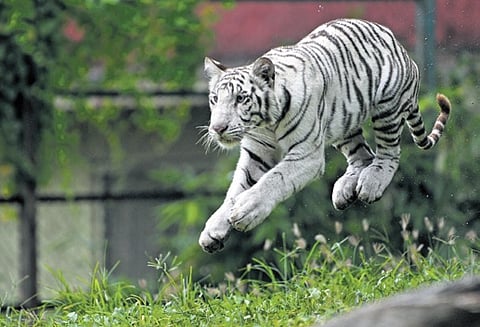

HYDERABAD: At Hyderabad’s Nehru Zoological Park, 12 white Bengal tigers, born and raised in captivity, continue to awe visitors. These striking cats, with snow-white coats and icy blue eyes, are not a separate species but Bengal tigers with a rare recessive gene. Their presence has made the zoo a national leader in white tiger conservation, second only to Odisha’s Nandankanan Zoo.
Though popular, breeding white tigers is controversial due to inbreeding risks. “We don’t breed indiscriminately,” said Zoo Director Sunil Hiremath. “To maintain genetic diversity, we cross-breed with orange tigers when necessary. A white cub may reappear by the third generation—but genetically stronger.”
Studbooks and zoo-to-zoo exchanges help avoid close-kin breeding. Breeding is delicate. Mothers and cubs are isolated for 15–20 days post-birth, monitored via CCTV. “Even minor disturbances can cause distress. A weak cub may not survive; in some cases, the mother may consume it,” Hiremath explained.
Despite the challenges, the zoo has reported no major deformities. Most tigers are healthy and active, with enriched enclosures to encourage natural behaviours. Young siblings stay together up to 18 months to foster bonding.
Illnesses can be hard to detect. “Tigers often hide symptoms until it’s too late,” Hiremath noted. Recently, two white tigers from Warangal’s Kakatiya Zoo were treated for leptospirosis and are now recovering.
While the tigers remain crowd favourites, officials say myths persist. “Many still think white tigers are a different species,” said one. The zoo plans to expand public education through digital exhibits, signage, and trained guides to set the record straight.
