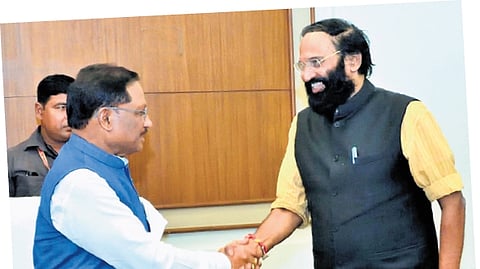

HYDERABAD: In a significant breakthrough, Chhattisgarh Chief Minister Vishnu Deo Sai has given in-principle approval to grant a No Objection Certificate (NOC) to Telangana for construction of the Sammakkasagar project on the Godavari river.
The decision came after Irrigation Minister N Uttam Kumar Reddy, accompanied by senior officials, met the Chhattisgarh chief minister in Raipur on Monday. Uttam thanked Vishnu Deo Sai for his positive response and described the decision as a long-awaited step towards realising the project.
Speaking to reporters later, Uttam said that he submitted a memorandum outlining Telangana’s commitment to take full responsibility for land acquisition, compensation and rehabilitation in Chhattisgarh. He also emphasised that the NOC was the final interstate requirement before the Central Water Commission could give its approval, without which the project cannot move forward.
In his PowerPoint presentation to the Chhattisgarh CM, Uttam said that the Sammakkasagar barrage was being constructed at Tupakulagudem in Mulugu district.
“Designed with a storage capacity of 6.7 tmcft at full reservoir level of +83 metres, it is located on the Godavari downstream of its confluence with the Indravathi. The project was conceived to address the acute water needs of Telangana, especially in the drought-prone and fluoride-affected districts of Nalgonda and Warangal,” he said and added that the project will not only help tackle drinking water scarcity in these areas but also provide irrigation benefits on a large scale.
To create new ayacut of over 12,000 hectares
“The Sammakkasagar project is envisaged to stabilise an ayacut of 1.78 lakh hectares under the Sriramsagar Project Stage-II and create a new ayacut of 12,146 hectares under the Ramappa-Pakhal Link Canal. This additional irrigation potential will benefit Warangal, Suryapet, Mahbubabad, Jangaon and Khammam districts, along with Nalgonda.
The project is expected to transform agriculture in these areas, reducing the risks associated with recurring droughts and ensuring more reliable water supply for crops,” he said while noting that this would directly contribute to higher agricultural productivity and secure livelihoods for farmers who have struggled with uncertainty for decades.
The minister also underlined the drinking water component, pointing out that Nalgonda and parts of Warangal have long been affected by groundwater contamination due to excessive fluoride levels. The Sammakkasagar Project is designed to reduce this dependence on groundwater by providing safe river-based water supplies. By addressing both irrigation and drinking water needs, the project is expected to serve as a lifeline for millions of people in Telangana’s most vulnerable regions, he added.
Uttam also said that while Telangana would benefit extensively, the project’s backwaters would extend into Bhoopalpatnam tehsil of Bijapur district in Chhattisgarh, resulting in some submergence. He explained that about 13.06 hectares of land, 54.03 hectares of river area and 6.35 hectares of nala land would be affected. Chhattisgarh had earlier conveyed its concerns about this impact. Telangana, he said, had recognised these apprehensions and approached the matter with seriousness.
Telangana ready to meet all costs, pay compensation
The minister recalled that Telangana had already offered to meet all costs associated with submergence, including land acquisition and rehabilitation in Chhattisgarh territory. The state had corresponded with Chhattisgarh on several occasions, seeking details of the likely costs of compensation and resettlement. He also noted that Chhattisgarh had entrusted the Indian Institute of Technology, Kharagpur, with conducting a study of the submergence, and that Telangana was ready to accept its findings and implement the recommendations.
Uttam also said that the Telangana government was willing to adhere to the suggestions of the Chhattisgarh government and pay compensation as per existing rules to affected landowners. To demonstrate its seriousness, Telangana had also proposed to make an advance lump-sum payment to the Chhattisgarh government. This advance, calculated on the basis of land acquisition norms, would be paid before or against the issuance of a Letter of Intent for the NOC. He said this step was aimed at removing any financial or administrative delays in the process of clearance.
He expressed hope that with the positive response from Vishnu Deo Sai, the matter would now move quickly to a formal conclusion. “The Sammakkasagar project is vital not only for Nalgonda and Warangal but also for stabilising irrigation across large parts of Telangana,” he added.
kEY features
Approach channels and gravity canals to carry water to command areas
3 pump houses and delivery cisterns designed to handle large volumes of discharge.
90 km tunnel network, divided into four tunnels of eight-metre diameter each, carrying a discharge capacity of 182 cumecs
Cross-drainage works, regulators and road bridges across canals
