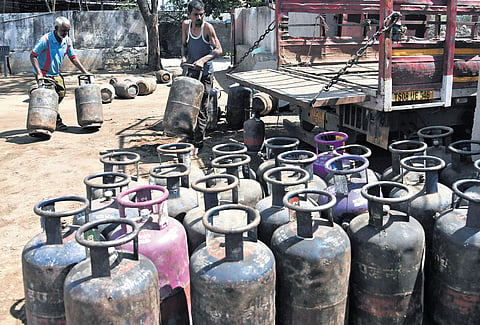

HYDERABAD: The LPG crisis in Telangana has taken a sharp and troubling turn, with rampant black marketing of cylinders crippling small businesses, exposing gaps in distribution, and forcing both consumers and eateries into desperate choices. While the government maintains that domestic supply remains stable and enforcement is underway, ground realities tell a far more distressing story — one of survival, exploitation, and a thriving underground market.
“We have spent around Rs 28,000 on cylinders in the last 10 days. Due to lack of supply, we are forced to buy cylinders in black just to keep our business running,” says Padma, who runs a small tiffin centre in AS Rao Nagar.
“Earlier, we used to earn around Rs 1,000 to Rs 1,200 profit, but now all our money goes into buying cylinders.”
Her voice captures the anxiety of hundreds of small food vendors across Hyderabad who are now battling soaring input costs, shrinking margins, and an uncertain future. “Some days, we open the shop with tension, not knowing if we will even have enough gas to last the day,” she adds.
“Customers think we are increasing prices, but they don’t know what we are going through,” says Kishan, a roadside dosa vendor in Ameerpet.
“If I don’t buy (cylinders) in black, I have to shut shop. If I buy in black, I don’t earn anything. Either way, we are losing,” he adds.
Most of the small eateries in the city have increased their prices by Rs 10 to Rs 20. A cup of tea that used to cost Rs 10 is now being sold at Rs 15. Many eateries are also levying an additional Rs 10 in the name of cylinder charges.
An eatery in Sindhi Colony, famous for pizza, was forced to buy a Rs 20,000 electric pizza machine due to non-availability of gas. “Earlier we used to run on five cylinders. Due to supply shortage, we are now using only three cylinders. We are forced to buy a commercial cylinder at Rs 7,500. We spent around Rs 30,000 on cylinders in just 10 days. If this situation continues, we don’t think we’ll be able to continue our business,” says eatery owner Venkat.

No supply from plants
LPG suppliers, meanwhile, admit that they are not receiving adequate stock of commercial cylinders from plants. “Commercial sale is minimal right now. We received stock only for about a week after the crisis began. Since then, there has been no supply from the plant,” says a source at a distribution centre.
The numbers reflect the severity — daily supplies have plummeted from 1,300 to 1,400 cylinders before the crisis to barely 100 now.
In this vacuum, black marketing has flourished. Industry insiders reveal that while the official price of a 19 kg commercial LPG cylinder stands at around Rs 2,300, desperate buyers are being forced to pay anywhere between Rs 6,000 and Rs 9,000 in the black market.
“People who can afford it are buying in black. The rest are either shutting down or drastically cutting down operations,” says Sandeep Balasubramanian, founder of Doki Doki, a Pan-Asian restaurant in Hyderabad. “This is not sustainable. You cannot run a food business when your primary fuel costs three to four times the actual price.”
‘Artificial shortage’
Explaining the nature of the black market, Hyderabad City Task Force DCP Vaibhav Raghunath Gaikwad says the issue goes beyond simple supply shortage.
“The major problem is artificial shortage. Some agents are deliberately holding back stock for four to seven days and then releasing it into the market at higher prices. They are taking advantage of panic and creating a situation where people are forced to buy in black,” he adds.
Revealing the details of a recent decoy operation conducted to bust a major scam, he says: “We received a complaint from a person who was forced to purchase cylinders at a higher rate. We conducted a decoy operation and traced it to an agent operating from Shamshabad, who was transporting cylinders and selling them in black from another location. We had arrested 10 persons and seized 376 cylinders (both empty and full) worth Rs 21,88,000.”
He, however, adds that identifying offenders is not always easy. “These operations are often done through known contacts. They don’t sell openly. That makes it difficult to track. We need verified information before taking action.”
Urging the public to remain cautious, he says: “Do not panic and do not purchase from the black market. There is sufficient supply. If people avoid panic buying, these illegal networks will automatically weaken.”
He also warns about cyber fraud linked to the crisis. “People should not trust unknown calls or messages offering gas cylinders. Fraudsters are also taking advantage of the situation.”
Impact visible across the city
According to industry estimates, both dine-in and delivery segments have witnessed a significant slowdown, with overall operations dropping by about 50%. Major restaurant chains and popular eateries have not been spared either. Well-known establishments like Krishnapatnam, Chutneys and Panchakattu have reportedly trimmed their menus, eliminating gas-intensive dishes.
Doki Doki’s Balasubramanian observes that a large number of restaurants have cut down their menus. “Anything that requires a high amount of gas has been removed. Some outlets have even shut down because they simply cannot operate without LPG,” he adds.
Naga Bharana, founder of the famous Panchakattu, which has five outlets in the city, says: “Due to shortage in commercial cylinders, we have removed uttapam and chutney from our menus. We used to operate on three dosa tavas, but now we are using just one.”
As the crisis deepens, businesses are scrambling for alternatives. “A lot of restaurants are moving to electric cooking, woodfire, or coal,” says Balasubramanian.
“We are seeing a surge in commercial electrical equipment — electric tawas, grinders, induction stoves. Even I have shifted nearly 50% of my operations to electric.”
However, this transition comes with its own limitations. While high-powered commercial induction units can handle cooking, they are slower. “What takes one minute on high-pressure LPG may take up to two minutes on electric. In bulk cooking, that delay matters. That’s why menus have become leaner.”
Infrastructure gaps
The crisis has also exposed infrastructure gaps. While some high-end hotels rely on piped natural gas (PNG), many restaurant-heavy areas lack such connectivity.
Meanwhile, the government insists it is taking strict action against black marketing. Civil Supplies Commissioner Stephen Raveendra states that from March 12 to April 6, a total of 1,864 cases have been booked against illegal refilling and black marketing, with 112 FIRs registered and 4,630 cylinders seized. Earlier data also shows that between March 12 and April 3 alone, 3,699 domestic cylinders and 70 small cylinders were seized, with the total value of confiscated property estimated at Rs 1.1 crore.
“We are focusing on habitual offenders and organised networks converting domestic cylinders for commercial use. We are working closely with the police and monitoring distributors and delivery personnel to prevent diversion,” Raveendra says, adding that penalties, in some cases, go up to three times the value of the seized goods.
However, despite enforcement, irregularities in delivery are raising serious concerns among consumers. At a government godown near Indira Park, several people complained of receiving delivery confirmation messages without actually getting their cylinders.
“We shared the OTP with delivery boys, got a message saying the cylinder was delivered, but they never came. Later, they stopped answering calls,” says a consumer.
Panic and manipulation
Authorities attribute the initial shortage to panic buying in the early phase of the crisis. However, as the DCP points out, the situation was worsened by both panic and manipulation. “When demand suddenly doubles, supply chains take time to adjust. But when artificial shortage is added to that, the impact becomes severe,” he says.
Yet, for small businesses, the crisis remains deeply personal. “We are not asking for subsidies,” says another small hotel owner. “We just want fair access. When cylinders are available in black at triple the price, it means something is wrong in the system.”
Back in AS Rao Nagar, Padma continues to run her tiffin centre, unsure of what awaits her the next week. “If this trend continues, we will have no choice but to shut down,” she says.
For now, the flames in many kitchens across Telangana are still burning — but at a cost few can afford, and one that is increasingly being dictated by the black market.