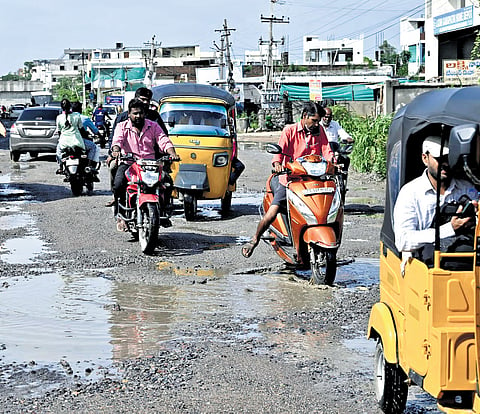

HYDERABAD: Even as rainfall activity eased across Telangana on Friday after two days of widespread downpours, the state continued to experience the impact of an unusually active monsoon spell. Mancherial recorded the highest rainfall in the past 24 hours at 17 cm, followed by Adilabad at 15 cm, while several northern districts remained under the influence of moisture-laden weather systems.
Although rain intensity has temporarily reduced, the state has witnessed a turnaround in its monsoon performance over the past fortnight.
Telangana entered July with a rainfall deficit of nearly 30%, raising concerns over the progress of the southwest monsoon. However, successive low-pressure systems over central India and the Bay of Bengal triggered widespread rainfall across the state during the second half of the month, bringing down the cumulative deficit to around 10%. The rapid recovery highlights how rainfall patterns are becoming increasingly volatile, with prolonged dry spells followed by episodes of intense precipitation.

EL Nino not the only factor
Meteorologists say the latest spell reflects a broader shift in monsoon behaviour, where traditional climate drivers such as El Nino are no longer the only factors determining rainfall patterns. Instead, warming oceans, increased atmospheric moisture and regional weather systems are playing a growing role in influencing rainfall distribution and intensity.
“The influence of El Nino on the Indian monsoon has become more complex in recent years because other factors, particularly the warming Indian Ocean and western Pacific, are also playing a significant role,” said S Stella, director of IMD Hyderabad. “A warmer atmosphere can hold more moisture, increasing the potential for intense rainfall events whenever favourable weather systems develop,” she added.
The observations align with findings from recent studies by the Indian Institute of Tropical Meteorology (IITM), the IMD and the Intergovernmental Panel on Climate Change (IPCC), which indicate that while the number of rainy days may not increase significantly, heavy rainfall events are becoming more frequent and intense in a warming climate.
A recent Climate Trends briefing also noted that multiple low-pressure systems and changing ocean conditions have offset El Nino’s usual suppressing effect on rainfall across several parts of India. Scientists involved in the analysis argue that the bigger challenge now is not predicting seasonal rainfall totals but forecasting where and when extreme rainfall events will occur.
The changing rainfall pattern is particularly significant for Telangana. IMD Hyderabad meteorologist G N Srinivas Rao said rapid urbanisation is strengthening Hyderabad’s Urban Heat Island effect, enhancing local convection and increasing the likelihood of intense, short-duration rainfall events over the city.
“At the same time, Hyderabad’s groundwater levels are also a concern. This means it is not just the amount of rainfall that matters, but also when and where it occurs. Rainfall distribution has become as critical as seasonal totals for managing water resources and reducing flood risks,” he said.
S Stella added, “We are seeing longer dry spells interrupted by short periods of very heavy rain. This poses serious challenges for water management, agriculture and disaster preparedness.”
Northern Telangana has witnessed a rise in high-intensity rainfall episodes over the past decade, resulting in flash floods, overflowing streams, even when seasonal rainfall remains close to normal.
With the IMD indicating that rainfall activity may remain subdued over Telangana for the next few days before another weather system develops, meteorologists say this July has reinforced a key message for the future: the state’s monsoon is increasingly being shaped by the combined influence of climate change, warmer oceans and regional weather systems, making rainfall more erratic and extreme than in the past.