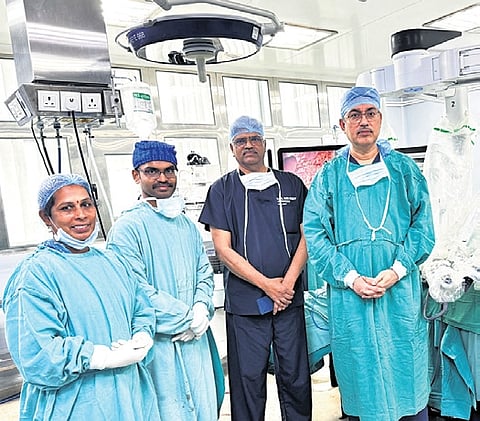

HYDERABAD: In less than three years, the Nizam’s Institute of Medical Sciences (NIMS) has recorded 1,000 robotic-assisted surgeries, with more than 90% of the procedures performed free of cost under the Aarogyasri and Chief Minister’s Relief Fund (CMRF) schemes. The achievement has earned praise from Chief Minister A Revanth Reddy and Health Minister Damodar Rajanarasimha.
The 1,000 robotic surgeries spanned a wide range of complex procedures across the three departments. Of these, 590 were performed by the department of Urology, including complex kidney transplants, prostate and bladder cancer surgeries, paediatric reconstructive procedures and advanced urinary tract reconstructions.
The department of Surgical Gastroenterology performed 248 procedures involving liver, pancreas, colorectal and upper gastrointestinal disorders, while the department of Surgical Oncology carried out 162 surgeries for ovarian, uterine, colorectal and other cancers using organ-preserving techniques.
Robotic tech has cut operating time: NIMS chief
Beyond the numbers, the real impact lies in patient recovery. Speaking to TNIE, NIMS director Dr Rahul Devaraj said robotic surgery has transformed patient care by improving surgical precision while significantly reducing recovery time. “The precision is maximum, blood loss is minimum, post-operative pain is less, recovery is much faster and the results are better. Most patients are discharged within 24 to 48 hours,” he said.
Besides improving recovery, robotic technology has also significantly shortened operating time, Dr Devaraj said. “Depending on the procedure, the operating time has almost halved. Our 999th and 1,000th robotic surgeries took only about one hour each, whereas similar open surgeries generally require two to three hours,” he said, noting that patients usually resume work within a week, reducing both healthcare costs and productivity losses.
Precision is another area where robotic surgery has an edge over conventional laparoscopy, Dr Devaraj said.
“There is no tremor to the hand, the cuts are more precise and the smaller ports cause less pain. Recovery is therefore much faster.”
The doctor noted that the technology has also sharply reduced blood loss during surgery. “Earlier, for major bladder or prostate cancer surgeries, we routinely kept three or four units of blood ready. Now I hardly remember a robotic surgery requiring a blood transfusion because we identify and control every blood vessel before significant bleeding occurs,” he said.
With demand for robotic procedures continuing to rise, NIMS is now planning to expand its programme by procuring another robotic surgical system. “We are trying to get another robotic system because of the increased workload. There are also plans to introduce robotic surgery for cardiac procedures,” Dr Devaraj told TNIE.
He added that future robotic platforms are expected to use single-port technology, allowing multiple robotic arms to operate through a single incision.
Later, Chief Minister A Revanth Reddy met NIMS director Dr Rahul Devaraj and said the People’s Government’s resolve to make state-of-the-art medical services accessible through government hospitals had been fulfilled. He appreciated the institute for performing more than 90% of the robotic surgeries free of cost under the Aarogyasri scheme and the Chief Minister’s Relief Fund (CMRF), noted that it had recently completed 2,000 kidney transplant surgeries, and expressed hope that NIMS would achieve many more milestones.
At a meeting in the state Secretariat, Rajanarasimha described the achievement as a major milestone for Telangana’s public healthcare system. He recalled that NIMS had performed South India’s first robotic kidney transplant in a government hospital and said robotic surgery facilities would be expanded to TIMS hospitals, Gandhi Hospital and the new Osmania Hospital.
