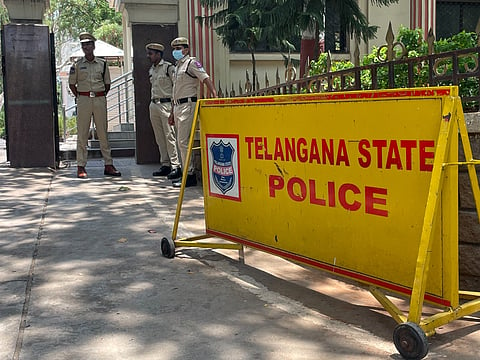

HYDERABAD: The Telangana Police on Wednesday launched the next-generation Telangana Emergency Response Support System (TG-ERSS), integrating police, fire, ambulance, women safety, child protection, disaster response and other emergency services under the single number ‘112’ to provide a unified emergency response platform across the state.
Powered by Artificial Intelligence and advanced location technologies, the platform prioritises emergency calls based on severity, filters duplicate and non-emergency calls, identifies callers’ locations, auto matically dispatches the nearest available response unit and supports voice-to-text transcription, real-time monitoring and performance analytics. According to the police, the upgrade has reduced overall call-centre processing time by nearly 30%.
DGP CV Anand, launching the platform, said Dial 112 would serve as the first point of contact for citizens during emergencies.
It is not a mere software upgrade: DGP
DGP CV Anand described the initiative as a comprehensive transformation of Telangana’s emergency response architecture rather than merely a software upgrade.
The platform has reduced the average time taken by call takers from 100 seconds to 69 seconds and dispatcher time from 90 seconds to 64 seconds, bringing the overall call-centre processing time down from 190 seconds to 133 seconds.
Anand said Telangana records an average emergency response time of about six minutes in urban areas, 15 minutes in rural areas and 10 minutes and 30 seconds across the state, compared with the national average of around 18 minutes.

Operating round the clock with 164 trained personnel and 900 SIP-based communication channels, the TG-ERSS Dial 112 Centre receives nearly 14 lakh Interactive Voice Response (IVR) calls every day. Of these, around 18,000 emergency calls are handled by call takers and about 7,500 incidents are dispatched to field units. The advanced call-filtering system screens unintended, child, blank, spam and silent calls, reducing operator workload and improving response efficiency.
A total of 1,860 patrol vehicles — 788 four-wheelers and 1,072 two-wheelers — have been digitally integrated with the platform across all 31 police units in Telangana. The system automatically identifies and recommends the nearest available patrol vehicle, enabling faster deployment, better utilisation of field resources and continuous monitoring of incidents from the time a call is received until it is closed.
As part of the next phase of modernisation, AI-enabled drones will be introduced on a pilot basis in the Hyderabad, Cyberabad, Malkajgiri and Future City commissionerates. They will function as aerial first responders, providing real-time visual intelligence during mishaps, disasters, law and order situations, crowd-related incidents, search and rescue operations and other emergencies.