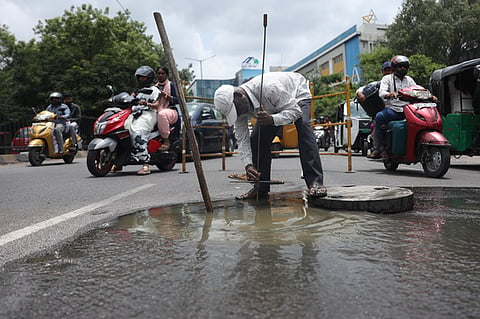

HYDERABAD: After successfully implementing a pilot project, the HMWSSB is set to deploy robotic inspection technology across all 12 zones to detect leaks, contamination, illegal connections and structural defects in underground pipelines. Officials said this move is expected to reduce complaint resolution time and improve water supply services across the city.
The decision follows a pilot project that demonstrated the technology’s ability to accurately identify faults in underground pipelines, enabling officials to locate and rectify problems more quickly.
The robotic inspection system will be introduced in Malkajgiri, Uppal, LB Nagar, Serilingampally, Kukatpally, Quthbullapur, Khairatabad, Secunderabad, Shamshabad, Rajendranagar, Charminar and Golconda. Dedicated teams equipped with robotic inspection systems, trained personnel, vehicles and maintenance support will respond to complaints and carry out inspections.
This move comes amid a large number of complaints related to water contamination, leakages and pipeline blockages, particularly in older localities and densely populated slum areas where ageing underground networks are difficult to access.
The robotic systems, equipped with high-resolution cameras, advanced sensors and AI-based defect detection, will inspect pipelines ranging from 100 mm to 250 mm in diameter. They can detect leaks, blockages, sediment build-up, cracks, damaged joints and other structural defects without extensive excavation. For pipelines larger than 250 mm, additional robotic equipment will be deployed whenever required.
Each inspection team is expected to handle 65 to 75 complaints a month. The teams will use one non-motorised PTZ camera inspection system for 100 mm pipelines and one motorised compact robotic inspection system for pipelines between 100 mm and 250 mm. All findings will be geo-tagged and integrated with the HMWS&SB’s digital systems.
Besides identifying defects, the robots will trace unauthorised water connections to help recover unaccounted-for water, reduce Non-Revenue Water (NRW) losses and generate video and spatial evidence for enforcement against illegal connections.
According to HMWSSB officials, the city currently relies on conventional maintenance methods to address water contamination, leakages and blockages. However, technical limitations often delay fault detection and repairs, leading to consumer dissatisfaction. The successful pilot has prompted the Board to scale up the technology to improve operational efficiency, reduce maintenance costs, shorten turnaround time for complaint resolution.
