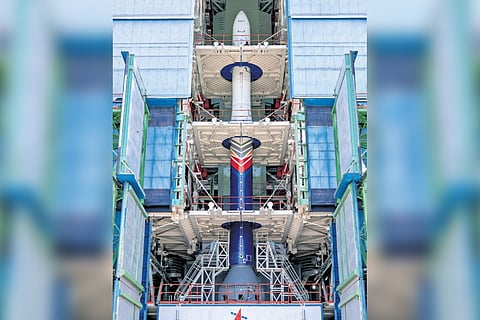

HYDERABAD: Skyroot Aerospace, a Hyderabad-based space company, has announced that the maiden test flight of the company’s Vikram-1 launch vehicle is scheduled between July 12 and August 4 at the Satish Dhawan Space Centre (SDSC-SHAR) in Sriharikota. Vikram-1 is reportedly India’s first privately developed orbital-class rocket.
The mission, Aagaman (Sanskrit for arrival), will reportedly mark India’s first attempt to place a privately built launch vehicle into orbit. It follows the successful launch of Vikram-S, India’s first privately built rocket to reach space in November 2022.
According to Skyroot, the primary objective of Mission Aagaman is to gather critical in-flight performance data across all major systems of the Vikram-1 rocket, including propulsion, stage separation, guidance, navigation, control and overall vehicle performance. The data will be used to validate the vehicle’s design and support the development of a reliable, high-frequency commercial launch programme.
“This data cannot be fully replicated through ground testing. The moment Vikram-1 lifts off, India’s private space industry will cross a milestone it has never achieved before,” said Skyroot Aerospace Co-founder and CEO Pawan Kumar Chandana.
The company said the maiden launch will be a partially commercial mission, carrying payloads from a mix of domestic and international customers. Full-scale commercial launches are expected after one or two successful demonstration missions. The company added that all stages of the Vikram-1 rocket have been successfully integrated and stacked at the launch pad.
Standing about seven storeys tall, Vikram-1 is a multi-stage orbital launch vehicle built using an all-carbon composite structure and powered by in-house developed propulsion systems, including 3D-printed engines and high-thrust solid rocket motors. The vehicle is designed to place satellites weighing up to 350 kg into Low Earth Orbit. Its maiden mission aims to inject payloads into a 450-km orbit at a 60-degree inclination.
