
HYDERABAD: A brain stroke left Balu’s father paralysed. It also left Balu determined to find a solution. A year later, the Osmania University biomedical engineering student has developed a prototype device that uses tongue movements to control electronic devices — a low-cost innovation that promises to reduce dependence on caregivers and restore a sense of independence.
M Balu, a third-year biomedical engineering student at the University College of Engineering (UCE), OU, has developed a wearable assistive device that enables people with paralysis or limb loss to operate electronic devices using simple tongue movements.
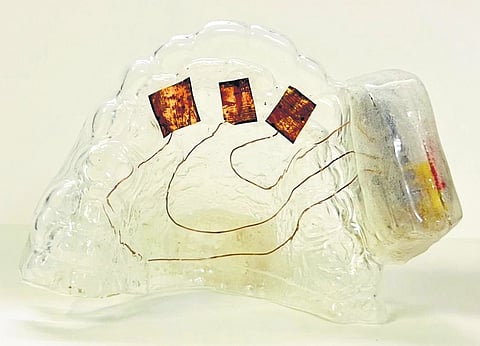
Called the “Tongue Capacitive Touch Control Assistive Device for Paralysed and Limb-Loss Patients”, the prototype is built into a customised dental aligner fitted with capacitive touch sensors. It detects tongue gestures and wirelessly transmits commands through Bluetooth Low Energy (BLE) Human Interface Device (HID) technology, allowing users to operate smartphones, laptops, wheelchairs and other Bluetooth-enabled devices without using their hands.
The project was encouraged by OU Vice-Chancellor Prof Kumar Molugaram and developed under the mentorship of Dr KE Ch Vidyasagar, assistant professor in the Department of Biomedical Engineering.
For Balu, the invention is deeply personal. “The idea came after my father suffered a brain stroke about a year ago. Watching him struggle made me realise how difficult life becomes when a person loses mobility. I wanted to create something that would help people interact with technology independently and reduce their dependence on caregivers,” he tells the TNIE.

The prototype uses a Seeed Studio XIAO ESP32-S3 microcontroller embedded inside a medical-grade thermoformed dental aligner. Two capacitive touch electrodes detect tongue movements, while a rechargeable 3.7V lithium-polymer battery powers the system. All electronic components are sealed inside the aligner to ensure safety in the oral environment, shares Balu.
At present, the device allows users to perform basic functions such as scrolling through smartphones using tongue-operated touch controls. Balu said future software upgrades could enable cursor movement, typing, wheelchair navigation and even control of smart home appliances.
“The tongue remains functional in many patients with severe paralysis. By using tongue gestures, they can operate electronic devices without relying on others for every small task,” he adds.
The prototype has been under development for nearly six months and is yet to undergo clinical trials. Balu plans to collaborate with medical professionals for patient testing before moving to the next stage of development. He also intends to file a patent and develop a companion mobile application with software developers to expand the device’s capabilities.
Designed as an affordable assistive technology, the device is expected to cost between `5,000 and `7,000 if commercially manufactured, making it significantly more accessible than many existing assistive systems.