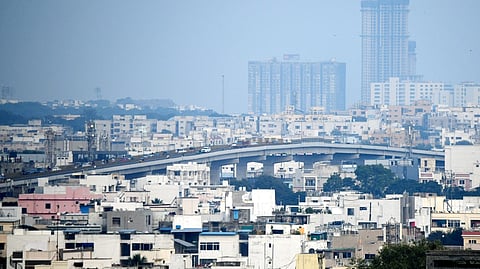

HYDERABAD: If the draft Core Urban Region (Integrated Governance) Bill, 2026, is implemented, property owners across Hyderabad’s core urban region may soon have to pay double the tax.
The Bill proposes replacing the existing Annual Rental Value (ARV)-based property tax system with a Capital Value System (CVS), a shift officials say is likely to significantly increase property tax collections and the tax payable by owners if the legislation is implemented.
The state government has released the draft Bill for public consultation, proposing to replace the nearly 70-year-old GHMC Act (originally enacted as the Hyderabad Municipal Corporations Act, 1955).
Citizens, Resident Welfare Associations, industry bodies and other stakeholders can submit suggestions until July 24 through their respective civic body (GHMC, CMC or MMC) website. The proposed legislation seeks to establish a unified governance framework for the Core Urban Region, while retaining decentralised administration at the corporation level.
Among the Bill’s most significant proposals is the shift from the ARV-based property tax system to a Capital Value System, under which tax will be linked to the market value of properties rather than their rental value.
Municipal officials said the change is expected to substantially increase property tax liability, with some estimates indicating it could nearly double for many property owners. The Bill also proposes rebates for timely payment of property tax while abolishing obsolete levies such as octroi and dog tax.

GHMC Commissioner RV Karnan said the existing GHMC Act has failed to keep pace with Hyderabad’s transformation from a city of around 15 lakh people to a metropolitan region with a population of about 1.30 crore. “The new legislation creates a unified governance framework for GHMC, CMC and MMC while preserving the core municipal structure,” he told TNIE.
Most existing provisions relating to municipal corporations, standing committees, commissioners, ward committees, elections, borrowing powers and basic property tax administration have been retained. The draft, however, proposes the inclusion of a transgender member in municipal authorities and removes certain outdated electoral disqualifications.
Climate Action Cell to steer Hyd to net-zero emissions
The Bill proposes a CURE Apex Governance Council and an Executive Committee, both to be chaired by the chief minister, to coordinate governance across the metropolitan region. It also proposes dedicated statutory bodies for disaster management, traffic management, climate action, heritage conservation, food safety, gender inclusion and labour welfare, while assigning HYDRAA responsibility for protecting lakes, drains and government land.
To strengthen digital governance, the Bill proposes a CURE Smart Governance Centre for real-time monitoring and emergency coordination, a single integrated portal for all permissions, licences and civic services, a Common Billing and Payment System with a consolidated bill covering property tax, water, sewerage, sanitation and other civic charges, digital notices and online service delivery across departments, and the establishment of a CURE Appellate Authority for speedy grievance redressal.
The Bill proposes GIS-based street development plans, universal accessibility standards, underground utility corridors, deemed approvals for building permissions, graded civil penalties instead of criminal prosecution in several cases and a single trade licence covering all businesses, including a regulatory framework for the night-time economy.
The government may also transfer certain municipal functions within the CURE region to the Telangana Industrial Infrastructure Corporation (TGIIC), subject to consultation and notification.
The legislation proposes creating a Climate Action Cell to steer Hyderabad towards net-zero emissions through waste reduction, renewable energy, resource recovery, urban forest restoration, lake conservation and water neutrality. It also envisages a CURE Traffic Management and Road Safety Authority, a Utility Coordination Committee, a Food and Nutrition Committee and a Heritage Committee to improve coordination across civic agencies.
A Capital Development Charge collected during building and layout approvals would be earmarked for water supply and sewerage infrastructure through an escrow mechanism benefiting the HMWSSB.
Obsolete provisions removed
The draft Bill also seeks to repeal several provisions inherited from colonial-era municipal laws, including penalties relating to bullock carts and stray cattle on city roads, reflecting Hyderabad’s changing urban landscape.
Officials said the CURE Bill aims to bring multiple urban agencies under a common legal framework, replacing the fragmented governance model under which GHMC functions under the GHMC Act while surrounding municipalities are governed by the Telangana Municipalities Act, 2019. If enacted, it would mark the most extensive overhaul of Hyderabad’s civic governance framework in seven decades.