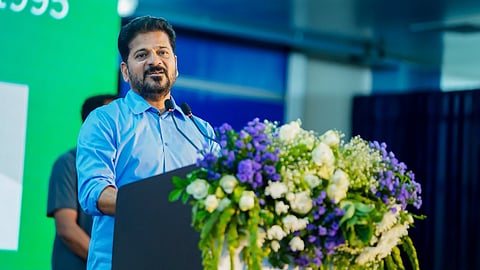

HYDERABAD: Chief Minister A Revanth Reddy on Thursday reiterated that his government is working with an ambitious target of contributing 10 per cent of the national GDP.
“Despite facing numerous political allegations, we are working with the goal of developing a Telangana that contributes 10 per cent of the national economy,” he said.
The chief minister was addressing the gathering after inaugurating the Premier Energies Limited’s Next-Gen Solar Module Manufacturing Facility at Seetharampur.
Reiterating the government’s resolve to transform Telangana into a USD 3 trillion economy by 2047, he said: “The present flow of investment is insufficient to compete globally. We must improve the infrastructure to attract more investments for robust economic growth in the future. We are striving to transform Telangana into the number one state in the country.”
The chief minister expressed serious concern over increasing pollution in Delhi which, he said, has become uninhabitable. “Cities like Bengaluru and Chennai are grappling with severe traffic issues,” he said.
Taking a serious note of increasing challenges in metropolitan cities in the country, the chief minister said that a slew of measures have already been initiated to ensure pollution-free development in Hyderabad.
“As part of this goal, the state has been divided into CURE, PURE and RARE zones for sustainable development. A 2,100 sq km area within the Outer Ring Road (CURE) was designed exclusively for the service sector,” he said.
Revanth further said that the Skills University and Advanced Training Centres were also established to upgrade the skills of the youth.
On Premier Energies’ new facility, he said: “It’s delightful to see a solar module manufacturing unit being inaugurated at Seetharampur.”
On the occasion, the chief minister expressed his gratitude to farmers of Rangareddy district for making the establishment of a solar manufacturing unit a possibility and ordered the district collector to provide housing and construct commercial complexes to provide livelihood for families who had to part with their lands.
