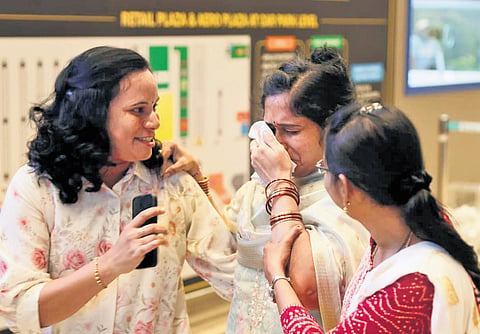

HYDERABAD: Sixteen Indian survivors of the tragic speedboat capsize near Vietnam’s Phu Quoc Island arrived safely at the Rajiv Gandhi International Airport (RGIA) in Hyderabad on Sunday, a day after the accident claimed the lives of 15 Indian tourists, including three from Andhra Pradesh. The tragedy has sparked serious concerns over tourist safety, emergency preparedness and the adequacy of rescue and medical response at one of Vietnam’s most popular island destinations.
According to Vietnamese authorities, the accident occurred on Saturday afternoon when a tourist speedboat overturned about 400 metres from the shore while travelling from May Rut Ngoai Islet to An Thoi International Port. The vessel was carrying 32 Indian tourists, three crew members and one Vietnamese tour guide when it encountered strong winds and high waves around 1 pm. Rescue teams launched an immediate operation and by around 3.30 pm, had accounted for all 36 people onboard. While 21 survived, 15 Indian tourists died at a hospital.
Among those who witnessed the accident was Govind, a tourist from Rajamahendravaram in Andhra Pradesh, who shared the horrifying sequence of events with TNIE. He said: “Our group had departed at around 10.30 am and travelled to Hon May Rut Ngoai island, close to the tourist destination of Phu Quoc, in three separate boats. After completing sightseeing and other activities, the first boat left the island around 12.45 pm, while his group was preparing to board the second vessel. “Just about 400 metres away from May Rut Ngoai island, we suddenly saw the first boat sinking. We immediately alerted the rescue teams,” he recalled.
According to Govind, survivors later told him that a massive wave struck the speedboat, causing it to lose balance before overturning. “The survivors said a huge wave hit the boat. It became unstable and capsized within moments. Even the rescue teams faced difficulties because of the rough sea conditions,” he said. He added that some tourists had reportedly questioned local guides about the rough weather before boarding, but were assured that the journey was safe and that there was nothing to worry about.
While rescue personnel managed to pull passengers from the water, Govind alleged that emergency medical facilities at the site were grossly inadequate. “There were no well-trained doctors, nor was proper medical treatment available immediately after the rescue. Had proper first aid been available, more people could have been saved,” he said. He claimed that only one or two oxygen cylinders were available despite the large number of victims who required urgent medical attention.
He said the presence of a junior doctor among their tourist group proved crucial. “Fortunately, one of the tourists in our group was a junior doctor. Under his guidance, we performed CPR on several unconscious victims and managed to save a few people,” Govind said.
According to him, 17 rescued passengers were initially taken to hospitals, where doctors declared 15 of them dead. The remaining two were admitted to the intensive care unit, with one reported to be in critical condition and the other stable.
Govind also highlighted the lack of basic rescue infrastructure, alleging that there were no stretchers to shift the injured from the rescue site. “We had to use bed sheets, dupattas and other pieces of cloth to carry rescued passengers because there were no stretchers available,” he said.
The speedboat reportedly had a seating capacity of 35 and was carrying 32 tourists, indicating that it was not overloaded. However, the tragedy has raised questions about weather monitoring, the decision to allow tourist boats to operate despite rough sea conditions, adherence to safety protocols and the adequacy of emergency medical facilities at the tourist destination. As the survivors returned home, grieving families continue to await the repatriation of the victims’ bodies while Indian authorities coordinate with their Vietnamese counterparts to facilitate the process.
