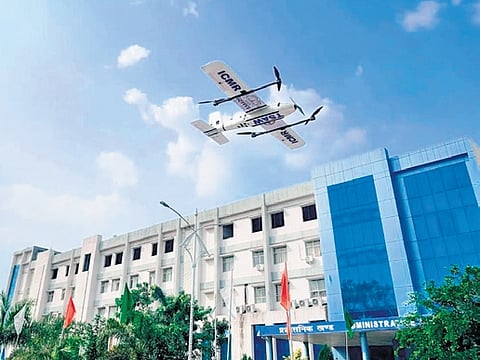

HYDERABAD: A pilot project using drones to transport tuberculosis (TB) sputum samples in Telangana’s Yadadri-Bhuvanagiri district has cut the median time taken to diagnose the disease from 15 days to five, while almost eliminating patients’ out-of-pocket expenses, according to a study by the Indian Council of Medical Research (ICMR).
The project, carried out under ICMR’s flagship i-DRONE initiative in collaboration with AIIMS Bibinagar and the district TB office under the National TB Elimination Programme (NTEP), tested whether drones could bridge the “last-mile” gap in healthcare by ferrying sputum samples from Primary Health Centres (PHCs) and sub-centres to TB diagnostic laboratories. The findings, published in the journal Digital Health, are based on data from 840 participants — 206 in the pre-drone phase and 634 during the drone intervention.
Before the project, many patients had to travel between 10 km and 30 km over poor roads to reach TB Units equipped with CBNAAT or Truenat testing facilities. Under the drone model, patients simply submitted sputum samples at their nearest PHC, while drones carried them to diagnostic centres, allowing doctors to begin treatment decisions much sooner.
The impact was reflected not just in turnaround time but also in the cost of getting diagnosed. The average out-of-pocket expenditure fell from about `9,451 under the conventional system to around `91 during the drone-assisted phase. More tellingly, the median expenditure dropped to zero, meaning many patients no longer had to spend on travel.
AIIMS Bibinagar officials said the intervention followed a hub-and-spoke model linking four TB Units with 11 PHCs and 60 sub-centres across Yadadri-Bhuvanagiri district. Instead of making long journeys to testing facilities, patients could leave their samples at nearby health centres, with drones taking care of the rest.
The improvement in reporting times was also striking. During the drone phase, 76.3% of patients received their test results the very next day, compared with just 1.5% before the intervention. At the same time, the proportion of cases where results took more than two days fell sharply from 92.2% to 16.3%.
Researchers also examined how healthcare workers adapted to the new system. A qualitative assessment involving 101 frontline workers found that, despite initial hesitation, the drone network was widely accepted. Many reported quicker movement of sputum samples and medicines, and smoother operations.
Drone operations were conducted between February 2024 and February 2025. While the trial highlighted the potential of drone-assisted healthcare logistics, researchers also flagged challenges such as weather disruptions, limited payload capacity, regulatory approvals and the need for continued training of healthcare workers. They noted that the findings are based on one district and that similar studies in different settings would be needed before the model is scaled up.
“The study demonstrates how technology can bridge geographical barriers and improve timely access to diagnosis, particularly for people living in remote areas,” said Dr Rajiv Bahl, Secretary, Department of Health Research, and Director General, ICMR.
