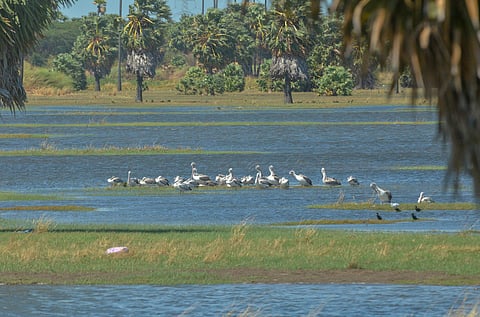

HYDERABAD: India has expanded its network of wetlands of international importance to 100 Ramsar sites, but Telangana remains without one, despite 25 new additions between 2023 and 2026.
The contrast is stark. Andhra Pradesh has one Ramsar site, Karnataka four, Maharashtra three, Chhattisgarh one, Odisha six and Tamil Nadu 20. Overall, 26 states and Union Territories now have at least one Ramsar wetland, leaving Telangana among the few without international recognition.
This is despite Telangana having more than 13,000 wetlands covering nearly five lakh hectares, according to the National Wetland Inventory. These include reservoirs, urban lakes and rural tanks that support groundwater recharge, flood mitigation, biodiversity and migratory birds.
The Telangana State Wetland Authority (TGSWA), constituted in 2018 under the Wetlands (Conservation and Management) Rules, was tasked with identifying and protecting wetlands. Activists, however, say little progress has been made.
“In 2024, five wetlands were shortlisted and discussed in a State Wetland Authority meeting, but since then there has been no clarity on whether any proposal was formally moved forward,” a source said.
She said the absence of regular authority meetings and public updates suggested the process had either stalled or was still under review.
Environmentalists blamed unchecked urbanisation, particularly around Hyderabad, for degrading wetlands. “Flooding is more visible in highly urbanised areas where natural drainage and lakes have been disrupted. Wetlands themselves are not the cause of floods; their destruction is,” the source said.
Environmentalist Donthi Narasimha Reddy said wetlands are vital for climate resilience. “Wetlands help regulate temperature, recharge groundwater and support biodiversity. Rising heat levels even during winter months show how urgently we need to protect water bodies,” he said.
A senior forest department official said Ramsar recognition involves strict ecological criteria and detailed studies. “Two wetland proposals were earlier submitted to the Centre. We are working on proposals, and once the first site is completed, the process for others will become easier,” the official said.
Experts say Ramsar status would strengthen conservation, improve monitoring, curb encroachments and pollution, and support eco-tourism and local livelihoods. With India now having 100 Ramsar sites, Telangana’s continued absence is likely to renew scrutiny of its wetland conservation efforts.
