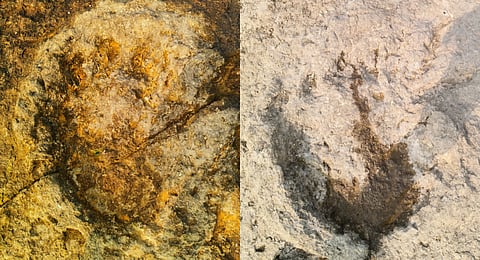

HYDERABAD: Nearly 200 million years after dinosaurs left their footprints in what is now Telangana, researchers fear the marks may not survive the next four to five years. Rising water levels, unchecked vegetation, erosion, weathering and human activity are threatening the fossil-bearing limestone beds near Saligaon village in Mancherial district.
The warning follows a paper published in the international journal Historical Biology in 2025. The study by Sanghita Dasgupta and Anthony Paul Rozario of IIT Bombay found that the Saligaon Tracksite marks the first occurrence of a sauropod dinosaur trackway in India and the first report of theropod dinosaurs from the Lower Jurassic Lower Kota Formation.
Located northeast of Saligaon village, the site preserves footprints embedded in limestone deposits of the Lower Kota Formation dating between 199 and 193 million years ago. While skeletal remains of Barapasaurus tagorei and Kotasaurus yamanpalliensis have previously been recovered from the formation, evidence showing how dinosaurs moved through this ancient landscape has remained scarce.
“The fossil footprints include tracks of both two-legged carnivorous theropods and four-legged herbivorous sauropods. Their coexistence at the same locality offers valuable insights into the ecosystem that existed in the region during the Early Jurassic,” said Sanghita Dasgupta, currently a Malaviya Post-Doctoral Researcher at Banaras Hindu University.

Among the most striking discoveries is a 14-metre-long sauropod trackway consisting of 13 hind-foot and 11 fore-foot impressions. Researchers estimate the animal was three metres tall at the hip and moved at 2.3 kmph. The tracks may have been left by an early eusauropod, part of the lineage that would eventually produce some of the largest land animals.
The site also preserves footprints of large predatory theropods assigned to the ichnogenera Eubrontes giganteus and Kayentapus hopii. Based on footprint size, some of these carnivores may have exceeded five metres in length, stood more than two metres tall at the hip and weighed close to 900 kg.
Together, the footprints offer insights into an ancient ecosystem where giant sauropods and large predatory theropods occupied the same landscape. Researchers believe the theropods lived around freshwater wetlands and lake margins, where they preyed on smaller vertebrates and young sauropods.
The discovery itself was almost accidental. “What initially appeared to be a handful of isolated footprints was later revealed to be an extensive track-bearing surface preserving evidence of dinosaur movement across an ancient landscape,” Dasgupta said.
Unlike isolated footprints reported earlier from the region, the Saligaon site preserves continuous trackways, allowing scientists to study walking patterns, movement and behavioural interactions. The impressions were formed when dinosaurs crossed soft mud along riverbanks and lake margins before being buried beneath layers of sediment and preserved in rock over millions of years.
Beyond Telangana, the discovery also adds to a growing understanding of dinosaur distribution across Gondwana, the ancient supercontinent that once connected India, Africa, South America, Antarctica and Australia. Comparable tracksites have been documented in several former Gondwanan regions, placing Saligaon in a much larger prehistoric story.
Researchers say the site has deteriorated noticeably since it was first documented. Areas clearly visible during field investigations in 2022 are now increasingly obscured by vegetation and waterlogging.
According to the researchers, the fossil impressions themselves are not easily damaged, but the exposed limestone surfaces that preserve them are gradually being affected by rising water levels, seasonal flooding, vegetation growth and natural weathering.
Human activity poses another challenge. “Residents have been removing stone from the area for construction purposes, and this has already affected parts of the bedrock that preserve these scientifically important footprints,” said Samudrala Sunil, a freelance palaeontologist and archaeologist.
“The dinosaur footprints are preserved on exposed bedrock. The bigger concern is not vegetation, but the force of water from the tank’s overflow structure, which falls directly on the fossil-bearing rock during the monsoon and could gradually damage it.”
As water levels rise, the monsoon approaches and vegetation continues to spread across the site, researchers warn that the window for conservation is rapidly narrowing. They argue that protecting the Saligaon Tracksite is crucial to preserving one of the country’s most significant records of dinosaur life.