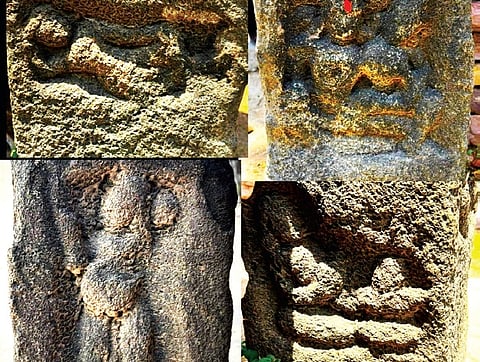

HYDERABAD: It is not often that a single monument tells multiple religious stories at once. But a 10th century stone pillar in Bhimsari village of Adilabad does exactly that, bringing together a rare depiction of the Buddha in Mahaparinirvana, Vishnu in his reclining Sayana posture, Uma-Alingana Murti showing Shiva embracing Parvati and a royal warrior holding a sword.
The sculpture was identified by Roddavaru Prithviraj, a history lecturer and member of Kotha Telangana Charitra Brundam, during a field visit to the village. The Buddha image, carved on one side of the four-faced pillar, depicts the moment of Mahaparinirvana, the Buddha’s final liberation from the cycle of birth and death.
“It is extremely rare to find Buddhist, Shaivite and Vaishnavite themes represented together on a single stone pillar,” Kotha Telangana Charitra Brundam convenor Sriramoju Haragopal said. “The sculpture reflects the religious harmony and artistic synthesis that characterised medieval Deccan society.”
According to Haragopal, the Mahaparinirvana sculpture closely follows classical Buddhist descriptions of Gautama’s final moments. “The reclining Buddha is shown lying on his right side with his head resting on his right hand; this corresponds closely with descriptions of the Buddha’s passing found in the Mahaparinibbana Sutta,” he told the TNIE.
The find is significant not only because of its multi-religious imagery but also because Mahaparinirvana sculptures are relatively rare in Telangana. While Buddha images have been reported from several temples and archaeological sites across the state, depictions of the Buddha’s final passing are far less common.

Art historian and sculptural expert Dr E Sivanagi Reddy, who examined the sculpture, said similar representations are known from only a handful of sites in Telangana. One of the earliest examples is found on the basement friezes of the 10th-century Bhimeswara Swamy Temple at Vemulawada in the Rajanna-Sircilla district, where a Dashavatara panel of Vishnu features both a seated Buddha image and a rare depiction of Buddha in Mahaparinirvana. Another example of a reclining Buddha in Parinirvana posture is preserved at the museum in Nagarjunakonda, one of South India’s most prominent Buddhist centres.
Scholars believe the Bhimsari sculpture dates to around the 10th century CE, when Buddhist imagery continued to feature in Hindu temple art despite the decline of organised Buddhism in the region. Similarities with the Vemulawada sculptures suggest that both may have emerged from the same artistic tradition, or perhaps even the same guild of sculptors.
Beyond its artistic value, the find is also a reminder of the rich but often overlooked heritage scattered across Telangana’s villages. Historians believe further exploration at Bhimsari could uncover more archaeological evidence and help piece together a little-known chapter of the region’s Buddhist past.
THE BUDDHAS OF GADWAL
Buddha images have also been reported from other medieval temple sites in Telangana, including the Surya Narayana Temple at Alampur (in picture) and the Papanasi temple complex there (both 10th century CE), where they appear among the Dashavatara carvings, and at a temple pillar at Pragatoor in Jogulamba Gadwal district.